Air Duct Cleaning in Youngstown
24/7 air duct cleaning in Youngstown and surrounding areas. IICRC-certified, insurance billing accepted. Call (724) 981-1441.
When you run your HVAC system and notice a thin layer of dust resettling on furniture within days of cleaning, or catch a stale, musty odor every time the heat kicks on, the problem is often living inside the ductwork itself. Over years of normal use, residential ducts accumulate dust, pet dander, pollen, mold spores, and in older Youngstown-area homes, construction debris from past renovations. That buildup recirculates through every room, every day, and no amount of filter changes will clear what’s already coating the duct walls.
What air duct cleaning actually involves
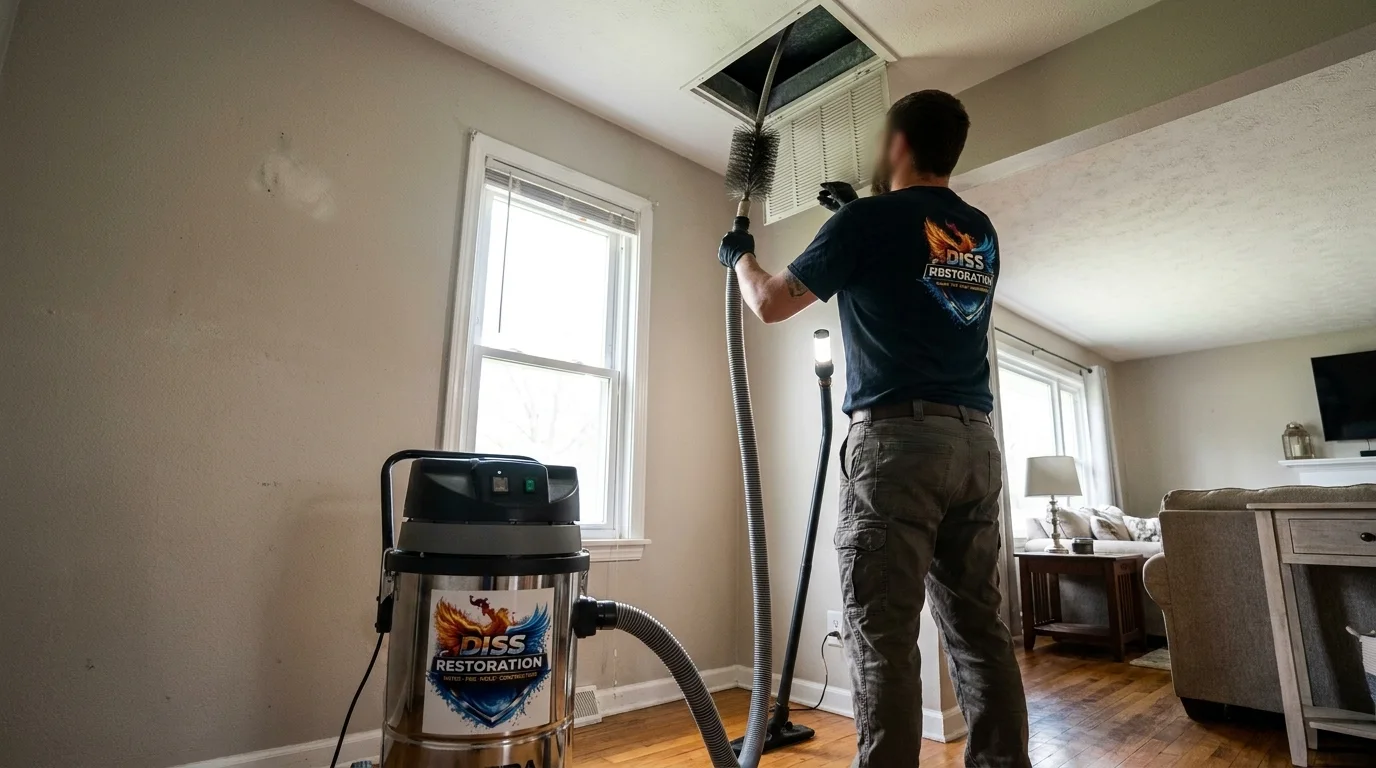
Professional duct cleaning is not a shop-vac run through a register. The work centers on negative-air pressure: a high-powered truck-mounted or portable vacuum unit is connected directly to the main trunk line, pulling airflow toward a single collection point while technicians work through each branch and supply register with rotating brush systems and compressed-air whips. This agitates debris off the duct walls and draws it into the vacuum rather than pushing it deeper into the system or out into living spaces.
Beyond the ducts themselves, a thorough cleaning addresses the air handler, blower compartment, evaporator coil housing, and return-air plenum, the components most commonly skipped by cut-rate operators. Dryer vent cleaning is typically performed in the same visit: lint accumulation in the exhaust line is a leading cause of residential fires and is worth clearing whenever the duct system is being serviced.
For homes where visible mold growth, rodent activity, or heavy microbial contamination is found inside the duct system, air duct sanitization, an EPA-registered antimicrobial applied after mechanical cleaning, is an additional step that addresses what a brush alone cannot.
A standard residential cleaning on a single-family home typically runs two to four hours depending on system size, age, and how accessible the ductwork is. Older homes with flex duct or undersized access panels take longer.
Our process
-
System inspection and pre-cleaning assessment. Before any equipment is connected, technicians walk the home to map the duct layout, identify the number of supply and return registers, note any visible damage, disconnected flex duct, or signs of moisture intrusion, and confirm whether the system has previously been cleaned. This determines which equipment configuration is appropriate and flags any conditions, active mold, animal intrusion, asbestos-wrapped duct insulation in pre-1980s construction, that change the scope of work.
-
Negative-pressure setup. A high-CFM vacuum unit is connected to the main trunk line, typically at the air handler, and the system is brought to negative pressure. All registers are sealed with foam covers except the one actively being cleaned, keeping dislodged debris moving toward the collection point rather than escaping into the room.
-
Mechanical agitation of each branch and register. Working register by register, technicians insert rotating brush systems and compressed-air tools into each supply and return run, breaking loose accumulated debris from the duct walls. Flexible duct sections require softer brush heads to avoid tearing the liner. The main trunk line receives a final pass after all branches are cleared.
-
Air handler and component cleaning. The blower wheel, evaporator coil housing, and drain pan are inspected and cleaned. Debris on the coil face reduces system efficiency and creates a surface where mold can establish; this step is what separates a full cleaning from a register-only service.
-
Sanitization and dryer vent service (where applicable). If microbial contamination is present or the homeowner requests it, an EPA-registered sanitizing agent is applied via ULV fogger or manual wipe-down after the mechanical cleaning is complete. The dryer exhaust vent is cleared of lint from the interior termination point to the exterior cap, and airflow is confirmed before the dryer is reconnected.
What separates a good duct cleaning from a bad one
The most common failure in duct cleaning is incomplete negative pressure, using an underpowered vacuum that cannot maintain suction across the full system, so agitated debris settles back into the duct rather than being collected. A properly sized unit will hold negative pressure measurable at the far registers while the vacuum is running.
The second most common shortcut is skipping the air handler. Cleaning the branch ducts while leaving a contaminated blower wheel or coil face means the system will re-contaminate the ducts within weeks. Any technician who does not open the air handler cabinet as part of the standard scope is not doing a complete job.
For homes with asbestos-wrapped duct insulation, common in Youngstown-area housing built before 1980, mechanical agitation inside the duct is not appropriate until the insulation condition is assessed. Disturbing deteriorating asbestos wrap during a duct cleaning creates a hazard far worse than dirty ducts. DISS Restoration’s team is EPA Lead-Safe Certified and OSHA trained, and pre-cleaning inspections account for this in older housing stock.
When duct cleaning is part of an insurance claim, typically following fire damage, flood, or a confirmed mold event, adjusters look for documentation of pre- and post-cleaning conditions, equipment logs showing negative-pressure readings, and evidence that the air handler components were addressed, not just the registers.
What does air duct cleaning cost?
Typical costs for residential HVAC duct cleaning vary based on system size, contamination level, and whether additional services like sanitization or dryer vent cleaning are included. Most homeowners pay somewhere in the ranges below, based on industry-typical figures, these are not DISS Restoration quotes, and every job is scoped individually before work begins.
| Scenario | Typical industry range |
|---|---|
| Standard residential cleaning, 1,500–2,500 sq ft home | $300 – $600 |
| Larger home or multi-zone system (2,500+ sq ft) | $500 – $900 |
| Air duct sanitization added to cleaning | $100 – $300 additional |
| Dryer vent cleaning (standalone) | $90 – $175 |
| Post-fire or post-flood duct cleaning with documentation | $600 – $1,500+ |
| Full system cleaning with air handler deep clean | $450 – $850 |
Routine duct cleaning is generally not covered by homeowners insurance. However, when duct contamination is a documented result of a covered loss, a house fire pushing soot through the HVAC system, a burst pipe introducing moisture into the air handler, or a mold event traced to a covered water intrusion, the cleaning and sanitization are typically part of the remediation scope that insurers do cover. DISS Restoration documents losses thoroughly and works with all major carriers.
Seasonal and regional considerations
In the Mahoning Valley, the combination of humid summers and homes that stay buttoned up through long heating seasons creates conditions where duct systems accumulate contamination faster than in drier climates. Many Youngstown-area homes were built between the 1920s and 1960s with gravity or early forced-air systems that have been retrofitted multiple times, meaning duct layouts are often irregular, access is limited, and the interior surfaces have decades of layered dust that resists a single pass with an underpowered system.
Spring is the most common time homeowners notice air quality issues, as heating season ends and the system transitions to cooling. Fall, before the furnace runs continuously again, is the practical window for cleaning, but the work is not seasonal and can be performed year-round.
Service area
DISS Restoration is based in Youngstown and serves the surrounding region including Boardman, Canfield, Warren, Niles, Austintown, Poland, Struthers, and communities throughout Mahoning and Trumbull counties. City-specific pages for each area link back here for full service and process detail.
If your HVAC system is circulating air that smells off, your filters are loading faster than they used to, or you’ve recently dealt with a fire, flood, or mold event, call (724) 981-1441 to schedule a duct inspection and cleaning scope, day or night, seven days a week.
Services We Handle
- Air Duct & HVAC Cleaning
Frequently Asked Questions
Does homeowners insurance cover air duct cleaning?
What is the difference between duct cleaning and duct sanitization, and do I need both?
How do I know if a duct cleaning company is actually doing the job right?
Can dirty ducts actually cause mold growth, or is that a scare tactic?
How often should residential ducts be cleaned, and what shortens that interval?
Looking for the best air duct cleaning company in Youngstown?
DISS Restoration provides air duct cleaning in Youngstown, OH and the surrounding area, and has served local property owners since 2021. Customers rate us 4.7 out of 5 stars across 63 Google reviews. We answer calls 24/7 — call (724) 981-1441 for immediate help.
Need Air Duct Cleaning now?
We respond 24/7 across Youngstown and surrounding OH cities.