24/7 Emergency Sewage Cleanup and Sanitization in Youngstown
24/7 emergency sewage cleanup and sanitization in Youngstown and surrounding areas. IICRC-certified, insurance billing accepted. Call (724) 981-1441.
Sewage backup in Youngstown? We answer 24/7. Call now and our crew heads out to contain the contamination and start the cleanup.
When a sewer line backs up or a septic system overflows, what comes up with the water is not just water. Raw sewage carries bacteria, viruses, and parasites that can colonize porous materials, drywall, subflooring, insulation, wood framing, within hours. The smell is the first warning, but the contamination spreads far beyond what you can see or smell. Standard water damage extraction equipment and household disinfectants are not enough. Sewage cleanup is a Category 3 biohazard response, and the margin for error is narrow.
What sewage cleanup and sanitization actually involves
Sewage losses fall under Category 3 water, the highest contamination classification in the IICRC S500 standard, regardless of whether the source is a municipal sewer line, a septic tank, or a floor drain backing up from a blockage downstream. That classification changes everything about how the work is done.
The visible pooling is only part of the problem. Sewage migrates laterally through flooring assemblies and wicks upward into wall cavities. Vinyl plank flooring that looks intact on top may be sitting on a saturated subfloor. Drywall that reads dry at the surface can have contaminated moisture trapped behind the baseboard. In older Youngstown-area homes, many built on slab or with shallow crawlspaces, sewage can reach areas that are genuinely difficult to access without opening walls or lifting flooring.
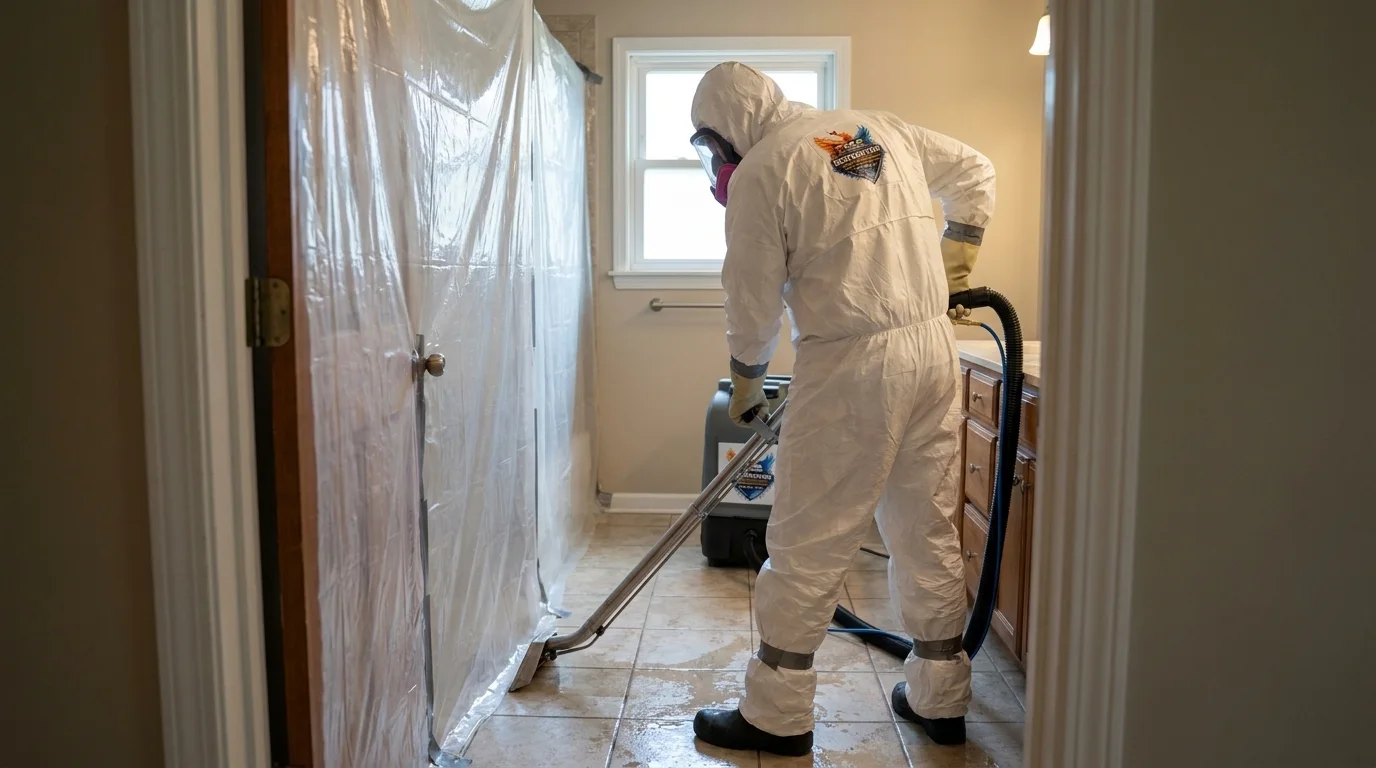
Proper remediation requires containment of the affected area, full removal of contaminated porous materials that cannot be adequately sanitized, application of EPA-registered antimicrobial agents to all affected surfaces, and verification drying before any reconstruction begins. The IICRC AMRT and WRT certifications held by our team inform how we assess secondary contamination, mold colonization can begin within 24 to 48 hours on wet organic material, and sewage losses accelerate that timeline.
Our process
1. Containment and personal protective staging Before extraction begins, the affected area is isolated with physical barriers to prevent cross-contamination to clean areas of the structure. The crew suits up in appropriate PPE, this is not optional on a Category 3 loss. Ventilation is assessed so that air from the contaminated zone is not recirculating through the home’s HVAC system.
2. Solid waste and standing water removal Visible solids are removed and bagged for proper disposal. Sewage-contaminated water is extracted using truck-mounted or portable extraction units, not shop vacuums. Every surface the water contacted is documented with photos and moisture readings before materials are touched.
3. Controlled demolition of non-salvageable materials Porous materials that absorbed Category 3 water, drywall, insulation, carpet, pad, and in some cases OSB subfloor, are removed to a clean margin. The IICRC S500 is explicit: contaminated porous materials cannot be dried in place and considered remediated. This step is where less thorough operators cut corners, and where problems resurface months later.
4. Antimicrobial treatment and surface sanitization All remaining structural surfaces in the affected area are treated with EPA-registered antimicrobial products appropriate for Category 3 contamination. This is applied systematically, not sprayed from a distance, and allowed to dwell at the contact time specified by the product label. A second application may follow depending on the extent of contamination.
5. Drying, verification, and clearance Commercial air movers and dehumidifiers are positioned to dry the structural cavity. Moisture readings are logged daily until affected assemblies reach dry standard. Only after verified drying is the area cleared for reconstruction. We document the full drying log, adjusters and contractors both need it.
What separates a good sewage response from a bad one
The most common failure in sewage cleanup is incomplete material removal. A crew that extracts the standing water, applies a disinfectant spray, and sets fans has not completed a Category 3 remediation, they have dried contaminated material in place. The odor may diminish temporarily, but the biological load remains, and mold typically follows within weeks.
A second failure point is inadequate containment. Without physical barriers and negative air pressure, remediation activity stirs up aerosolized contaminants and spreads them to unaffected rooms. OSHA-trained technicians understand the respiratory and cross-contamination risks and stage the work accordingly.
Insurance adjusters look for a complete moisture log with daily readings, a photo-documented scope showing affected materials before and after removal, and evidence that antimicrobial treatment was applied to a clean substrate, not over contaminated material. A well-documented sewage claim moves faster and with fewer disputes than one supported only by a final invoice.
What does sewage cleanup and sanitization cost?
Typical costs for sewage backup cleanup depend heavily on how far the contamination spread, how many materials require removal, and whether the loss affected a finished basement, a crawlspace, or living areas. Most homeowners pay somewhere in the ranges below, these are industry-typical figures, not DISS Restoration quotes.
| Scenario | Typical range |
|---|---|
| Single bathroom, contained backup, minimal spread | $1,500 – $3,500 |
| Finished basement, partial flooding | $4,000 – $9,000 |
| Finished basement, full flooding with subfloor involvement | $8,000 – $18,000 |
| Crawlspace sewage intrusion | $3,500 – $10,000 |
| Main-level living area, sewer line failure | $6,000 – $20,000+ |
Every loss is different, and DISS Restoration provides a written scope of work before any remediation begins. Standard homeowners insurance policies typically cover sudden and accidental sewer or drain backups if the policy includes a sewer backup rider, coverage is not automatic, and the endorsement limit matters. We work with all major carriers and provide the documentation adjusters need to process the claim.
Seasonal and regional considerations
In the Mahoning Valley, aging combined sewer infrastructure and clay-tile lateral lines are common in neighborhoods built through the mid-twentieth century. Heavy spring rainfall and rapid snowmelt can overwhelm municipal systems and push sewage back through floor drains and basement toilets, often with little warning. Homes with older cast-iron or clay drain lines are also at elevated risk of root intrusion and line collapse, which can cause recurring backups. If a backup has happened once, the underlying drain condition is worth investigating before it happens again.
Service area
DISS Restoration is based in Youngstown and responds to sewage backup cleanup and sanitization calls throughout the surrounding region, including Boardman, Austintown, Canfield, Warren, Niles, Hubbard, and communities across Mahoning and Trumbull counties. Service-area-specific pages are linked throughout the site for homeowners searching by city.
If sewage has backed up into your home, the clock on contamination spread is already running. Call DISS Restoration at (724) 981-1441, we respond 24/7, and we will walk you through immediate steps to limit exposure while our crew is on the way.
Services We Handle
- Basement Sewage Cleanup
- Category 3 Water Cleanup
- Cleaning & Sanitizing
- Sewage Backup Cleanup
- Sewage Backups
- Sewage Cleanup & Remediation
- Sewage Damage
- Water Damage Sewage Cleanup
Frequently Asked Questions
Does homeowners insurance cover sewage backup cleanup?
Is sewage backup water the same as regular water damage, or is it treated differently?
What materials typically have to be removed after a sewage backup?
What should I do — and not do — while waiting for the crew to arrive?
How long does sewage cleanup and sanitization take from start to finish?
Looking for the best sewage cleanup and sanitization company in Youngstown?
DISS Restoration provides sewage cleanup and sanitization in Youngstown, OH and the surrounding area, and has served local property owners since 2021. Customers rate us 4.7 out of 5 stars across 63 Google reviews. We answer calls 24/7 — call (724) 981-1441 for immediate help.
Need Sewage Cleanup and Sanitization now?
We respond 24/7 across Youngstown and surrounding OH cities.
Related Coverage
- Our Restoration Services
- Contact DISS Restoration
- 24/7 Emergency Sewage Cleanup and Sanitization in Austintown
- 24/7 Emergency Sewage Cleanup and Sanitization in Boardman
- 24/7 Emergency Sewage Cleanup and Sanitization in Canfield
- 24/7 Emergency Sewage Cleanup and Sanitization in Girard
- 24/7 Emergency Sewage Cleanup and Sanitization in Hubbard
- 24/7 Emergency Sewage Cleanup and Sanitization in Niles
- 24/7 Emergency Sewage Cleanup and Sanitization in Struthers
- 24/7 Emergency Sewage Cleanup and Sanitization in Warren