24/7 Emergency Water Damage Restoration in Youngstown
24/7 emergency water damage restoration in Youngstown and surrounding areas. IICRC-certified, insurance billing accepted. Call (724) 981-1441.
Water damage emergency in Youngstown? We answer 24/7. Call now and our crew heads out to stop the water and start drying your property.
Standing water moves fast. Within the first hour, it wicks into drywall, saturates insulation, and begins softening the wood framing behind your baseboards, none of which is visible from the surface. By 24 to 48 hours, the conditions for mold colonization are already forming in cavities you can’t see and may not smell yet. Water damage restoration is a race against a timeline that most homeowners don’t know is already running.
What Water Damage Restoration actually involves
Restoration after water intrusion is not drying out a wet floor. It’s a structured process of extraction, evaporation, dehumidification, and verification, each stage dependent on the one before it, and each measured with instruments rather than guessed at by feel.
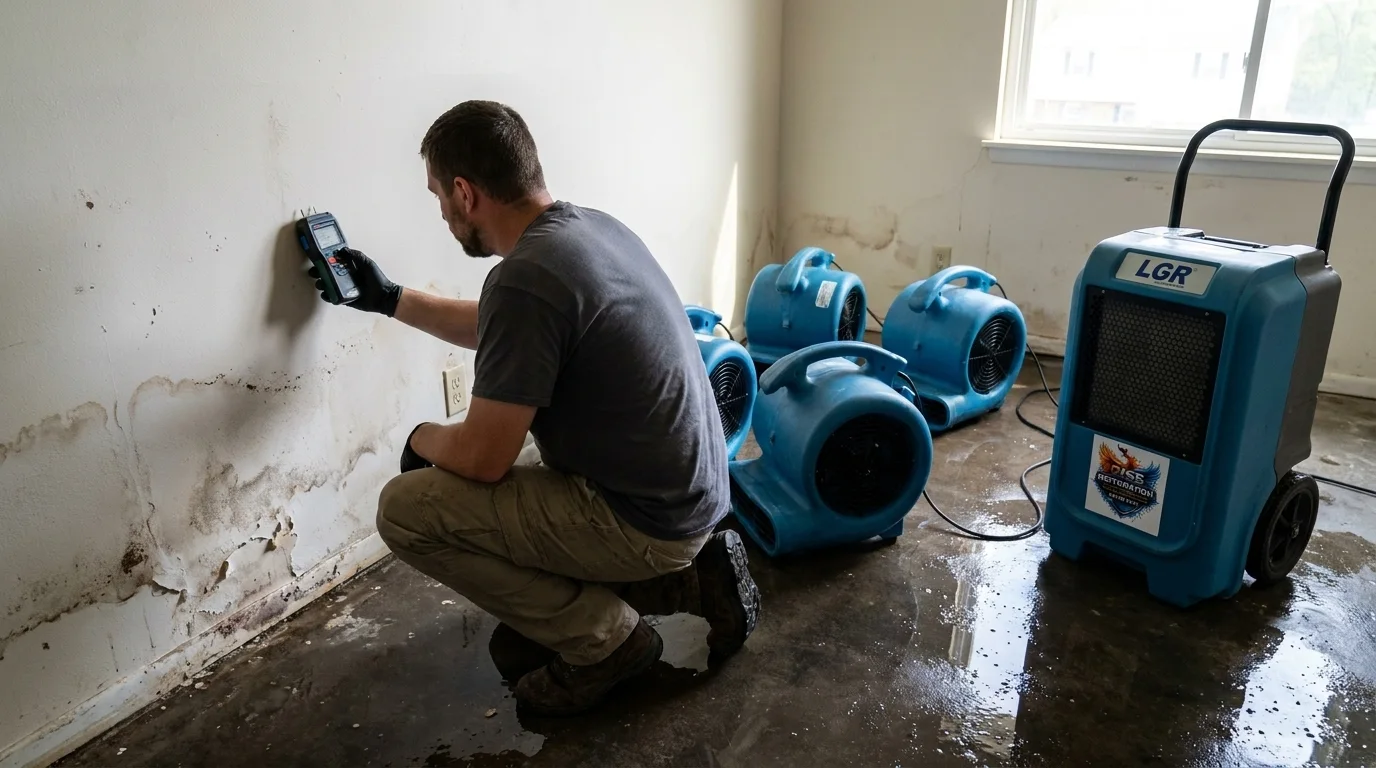
The equipment matters. Truck-mounted or portable extractors pull standing water from carpet, subfloor, and hard surfaces far faster than any shop vac. High-velocity air movers are positioned to create airflow patterns that accelerate evaporation from structural cavities, not just the surface. Refrigerant and desiccant dehumidifiers pull that evaporated moisture out of the air before it can re-deposit into unaffected materials. Thermal imaging cameras and penetrating moisture meters map where water has traveled behind walls and under flooring, because water follows gravity and capillary action, not the path you expect.
Timeline depends on the category and class of the loss. Clean water from a burst supply line dries faster than gray water from an appliance overflow, which dries faster than black water from a sewer backup, and each category carries different contamination protocols. Class 1 losses (water confined to a small area, low porosity materials) may reach drying goals in two to three days. Class 3 losses, where water has saturated walls, ceilings, and insulation, routinely require five to seven days of active drying with daily monitoring.
Our process
-
Emergency water extraction. The first priority is removing bulk water. Extractors pull water from carpet, pad, hardwood, and structural assemblies before drying equipment is ever staged. Leaving standing water in place while setting up air movers is a sequencing error that extends the overall drying timeline.
-
Moisture mapping and contamination assessment. Before a single air mover is placed, the full extent of the loss is documented, thermal imaging, penetrating meter readings at multiple wall heights, and subfloor checks. This map determines equipment placement, identifies materials that need to be removed rather than dried in place, and establishes the baseline readings that drying progress is measured against. For Category 2 or Category 3 losses, contamination boundaries are established and containment is staged accordingly.
-
Structural drying with calibrated equipment placement. Air movers and dehumidifiers are positioned based on the moisture map, not by feel. The IICRC S500 standard guides drying system design, including the ratio of air movers to dehumidifiers and the psychrometric targets the system needs to hit. Equipment is not simply left running; placement is adjusted as readings change.
-
Daily moisture monitoring and documentation. Drying is not a set-it-and-forget-it process. Readings are taken daily at every monitoring point established in step two. Progress is logged, and the drying system is reconfigured when materials are not trending toward drying goals. This documentation also becomes part of the insurance claim file.
-
Final clearance and scope for reconstruction. When all affected materials reach their drying goals, verified by instrument, not appearance, the mitigation phase is complete. Any materials removed during the process (cut drywall, saturated insulation, damaged flooring) are documented with photos and measurements so that reconstruction scope can be written accurately.
What separates a good water damage response from a bad one
The most common failure in water mitigation is incomplete moisture mapping at the start. Water behind plaster or stucco can read dry at the surface while the lath and framing behind it remain saturated for weeks. Operators who rely on surface readings alone, or who skip thermal imaging, miss secondary damage that surfaces later as mold growth or structural deterioration, often after the claim has closed.
A second common gap is under-sizing the drying system. Placing two air movers in a room that requires six, or running a single residential dehumidifier against a Class 3 loss, produces readings that trend slowly or plateau, extending the job, increasing the chance of secondary damage, and raising the total cost. Insurance adjusters reviewing a claim file look at daily moisture logs and equipment deployment records. A file that shows appropriate equipment from day one, with daily readings trending toward goal, supports the claim. A file with sparse documentation or equipment that doesn’t match the scope raises questions.
For Category 2 and Category 3 losses, gray water and black water, containment and antimicrobial treatment are not optional steps. Distributing contaminated water vapor through an uncontained space by running air movers without proper containment is a protocol failure that can expand the affected area and create liability.
What does Water Damage Restoration cost?
Typical costs for water damage restoration vary significantly based on the size of the affected area, the category of water involved, and how much structural material needs to be removed and replaced. Most homeowners pay somewhere in the ranges below for the mitigation phase alone, reconstruction of removed materials is a separate scope.
| Scenario | Typical industry range |
|---|---|
| Single room, clean water (Category 1), Class 1 | $1,200 – $3,500 |
| Single room, gray water (Category 2) with containment | $2,500 – $6,000 |
| Multiple rooms, clean water, Class 2–3 loss | $4,000 – $10,000 |
| Finished basement, clean to gray water | $5,000 – $15,000 |
| Sewage backup (Category 3), single bathroom | $3,500 – $8,000 |
| Whole-floor loss, Category 2–3, with material removal | $10,000 – $30,000+ |
These are typical industry figures, every loss is different, and DISS Restoration provides a written scope before any work begins. Homeowners insurance generally covers sudden and accidental water damage (a burst pipe, appliance failure, roof leak from a storm) but typically excludes damage from gradual leaks or maintenance neglect; your adjuster can confirm what applies to your specific policy.
Seasonal and regional considerations
Youngstown’s climate creates predictable pressure points for water intrusion. Freeze-thaw cycles through late winter and early spring are the primary driver of burst pipes in the region, older housing stock throughout Mahoning County tends to have supply lines running through uninsulated exterior walls or unheated crawl spaces, which are the first to freeze during a hard cold snap. Sump pump failures during spring snowmelt are a close second; when the ground is still partially frozen and melt water has nowhere to go, basement intrusion happens quickly and at volume.
Summer brings its own pattern. Youngstown’s humidity levels through July and August mean that any moisture left in a structural assembly, even a small amount, has ideal conditions for mold to establish. A loss that might be forgiving in a drier climate requires tighter drying timelines here.
Older homes throughout the city, many built in the early to mid-twentieth century with plaster walls, cast iron drain lines, and clay sewer laterals, present specific challenges. Plaster holds moisture differently than modern drywall, and clay laterals that have shifted or cracked are a recurring source of Category 3 intrusion.
Service area
DISS Restoration is based in Youngstown and provides water damage restoration throughout the surrounding region, including Boardman, Canfield, Austintown, Niles, Warren, Hubbard, and communities across Mahoning and Trumbull counties. Individual city service pages are linked from the main service area section of the site.
If you’re seeing water where it shouldn’t be, or smelling something that appeared after a recent leak, call (724) 981-1441 to schedule your moisture assessment. The sooner the extent of the loss is mapped, the more material can be saved.
Services We Handle
- Carpet Water Damage
- Carpet Water Extraction
- Fire and Water Damage Restoration
- Hardwood Floor Water Damage
- Laminate Floor Water Damage
- Water Damage Cleanup Repair
- Water Damage Flooring
- Water Damage Repair
- Water Damage Under Flooring
- Water Mitigation
- Water Removal Drying
- Wet Carpet Drying
- Wet Drywall Repair
- Wood Floor Water Damage Repair
Frequently Asked Questions
Does homeowners insurance cover water damage restoration?
How long does structural drying actually take, and what affects the timeline?
What's the difference between Category 1, 2, and 3 water, and does it change what gets done?
What should I do — and not do — while waiting for the crew to arrive?
How do I know when drying is actually complete — and why does it matter?
Looking for the best water damage restoration company in Youngstown?
DISS Restoration provides water damage restoration in Youngstown, OH and the surrounding area, and has served local property owners since 2021. Customers rate us 4.7 out of 5 stars across 63 Google reviews. We answer calls 24/7 — call (724) 981-1441 for immediate help.
Need Water Damage Restoration now?
We respond 24/7 across Youngstown and surrounding OH cities.
Related Coverage
- Our Restoration Services
- Contact DISS Restoration
- 24/7 Emergency Water Damage Restoration in Austintown
- 24/7 Emergency Water Damage Restoration in Boardman
- 24/7 Emergency Water Damage Restoration in Canfield
- 24/7 Emergency Water Damage Restoration in Girard
- 24/7 Emergency Water Damage Restoration in Hubbard
- 24/7 Emergency Water Damage Restoration in Niles
- 24/7 Emergency Water Damage Restoration in Struthers
- 24/7 Emergency Water Damage Restoration in Warren
- Burst Pipe Emergency Checklist: Step-by-Step Response
- What To Do in the First 24 Hours After Water Damage
- How To Choose a Restoration Company in Youngstown (Without Getting Burned)