24/7 Emergency Water Damage Restoration in Austintown
24/7 emergency water damage restoration in Austintown, OH. IICRC-certified, insurance billing accepted. Call (724) 981-1441.
Our IICRC-certified technicians are dispatched from our Youngstown, OH headquarters and are typically on-site in Austintown within 60 minutes of your call.
Austintown sits in Mahoning County’s glacially flattened terrain, where clay-heavy soils slow drainage and turn a burst pipe or a backed-up sump into a standing-water problem faster than homeowners expect. When water gets into a finished basement or crawl space here, it doesn’t just sit, it wicks into block foundation walls and subfloor assemblies within hours, and Austintown’s older housing stock means those materials are often less forgiving than what you’d find in a newer suburb. DISS Restoration responds 24/7 from Youngstown, and our IICRC-certified team brings the extraction equipment and structural drying expertise the job actually requires.
Why Austintown Properties See Water Damage Issues
Mahoning County’s clay-dominant soils are notoriously slow to absorb surface water, which means heavy rain events push water toward foundations rather than away from them. Austintown’s residential neighborhoods include a significant number of homes built between the 1950s and 1970s, an era when basement waterproofing standards were minimal and sump pump installation was often an afterthought. Many of those homes have block or poured concrete basements that developed hairline cracks over decades of freeze-thaw cycling, and those cracks become water pathways the moment hydrostatic pressure builds outside the wall.
Winter is a particular risk period. When temperatures in the Youngstown metro swing from the low teens to above freezing within a day or two, a pattern that repeats throughout January and February, supply lines in uninsulated exterior walls and garage ceilings are vulnerable to freezing and then rupturing as they thaw. The resulting release can dump dozens of gallons into wall cavities before anyone notices a wet floor.
Our Water Damage Restoration Process in Austintown
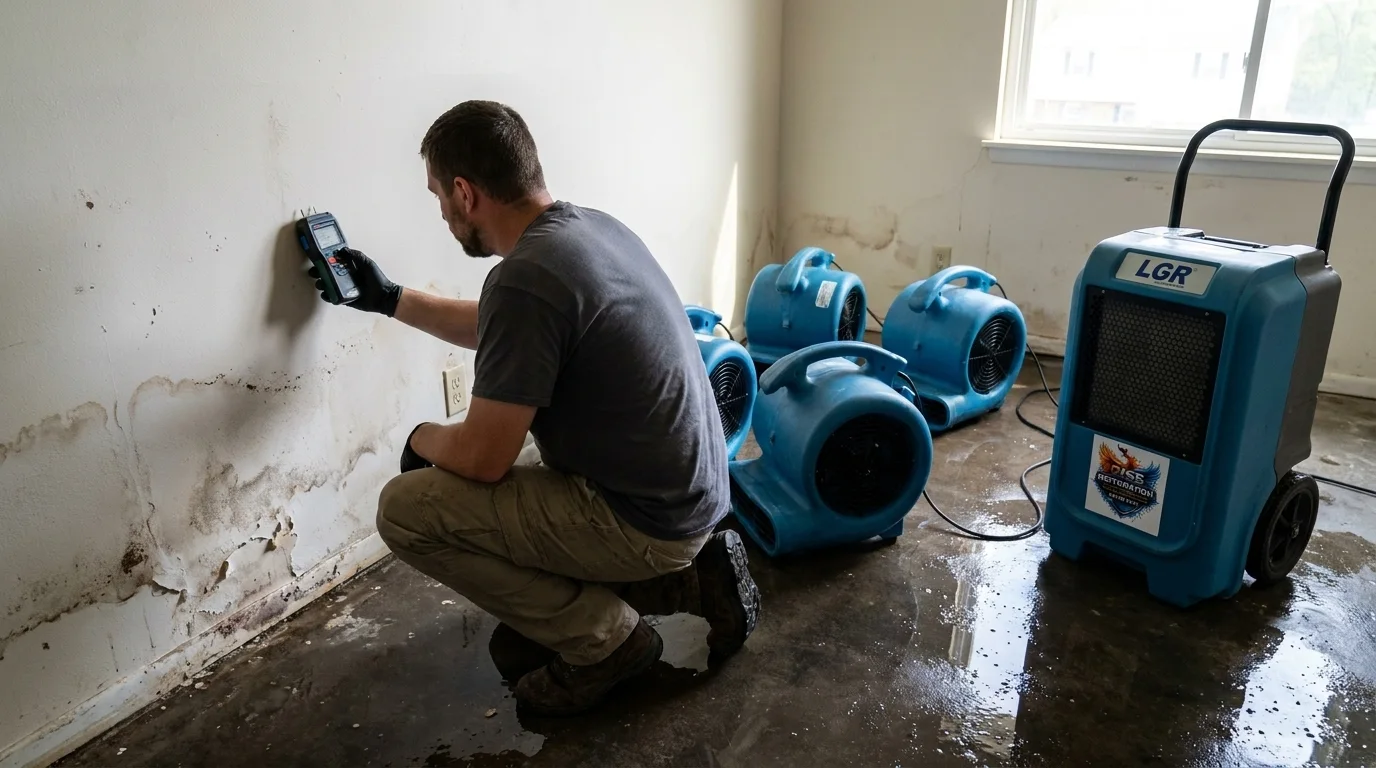
The first priority when we arrive is stopping the spread. We locate the moisture boundary using thermal imaging and calibrated moisture meters, not just the visible wet area, which is almost always smaller than the actual affected zone. Water behind plaster or under vinyl flooring reads dry at the surface while the substrate stays saturated, and drying to the surface only leaves a hidden mold condition.
Once we’ve mapped the loss, we extract standing water with truck-mounted and portable extraction units, then set a drying system calibrated to the materials present. Structural drying in an Austintown block-wall basement follows a different protocol than drying a modern OSB subfloor, block releases absorbed moisture slowly, and drying times need to account for that. Our team holds IICRC certifications in Water Restoration (WRT) and Applied Structural Drying (ASD), so the drying plan is built around the actual materials and moisture readings, not a generic timeline.
We monitor daily, adjusting equipment placement as readings change, and we document every reading for the insurance file.
Reaching Austintown from Youngstown
Our Youngstown base puts us a short drive from Austintown via Mahoning Avenue or U.S. Route 224, two of the main corridors connecting the two communities. Because we operate 24/7, a call at 2 a.m. after a pipe failure gets the same crew response as a call during business hours, there’s no answering service routing you to a next-day callback when water is actively spreading through a finished lower level.
Austintown Insurance Coordination
Most homeowner policies cover sudden and accidental water losses, a burst pipe, an appliance failure, an ice-dam backup, but the documentation has to be thorough enough to support the claim. We photograph affected materials before anything is moved, log moisture readings at each monitoring visit, and produce a drying report that carriers and adjusters can work from directly. We bill most major insurance carriers and can communicate with your adjuster throughout the process so you’re not translating between restoration and insurance language on your own.
Local Note
Austintown’s mid-century ranch and split-level homes frequently have original cast-iron or galvanized steel drain lines that have narrowed significantly with mineral buildup over the decades. When a sewer backup or washing machine overflow occurs, the source of the problem is sometimes the drain line itself rather than anything that happened upstream. We flag this when we see it during the assessment, not because plumbing repair is our scope, but because sending water back through a compromised line during extraction can make the situation worse. Knowing the plumbing vintage of the house shapes how we approach the job.
If you’re dealing with water in your home or business right now, call DISS Restoration at (724) 981-1441. We’re available around the clock, and we’ll get the right equipment to your Austintown address as quickly as possible.
Serving Austintown from our Youngstown headquarters — ★ 4.7 · 63 Google reviews
“This restoration company was able to take our weather related water intrusion job from start to finish within a very reasonable timeframe. The people we worked with communicated their next steps and asked questions when needed. The construction manager was always super quick to respond to my…” — Debbie, September 2026Read our reviews on Google →
Water Damage Restoration in Austintown: Service Coverage
Frequently Asked Questions
How fast can you arrive for water damage restoration in Austintown?
How quickly can DISS Restoration reach Austintown for a water emergency?
Are Austintown's older ranch and split-level homes harder to dry after a water loss?
Does Mahoning County's clay soil affect how water damage develops in Austintown basements?
What does the structural drying process look like inside an Austintown home?
Will my homeowner's insurance cover water damage from a burst pipe in Austintown, and how does billing work?
Water Damage Restoration response in Austintown
Most Austintown calls see a technician on-site within 60 minutes from our Youngstown headquarters.