
Mold Remediation in Austintown
24/7 mold remediation in Austintown, OH. IICRC-certified, insurance billing accepted. Call (724) 981-1441.
Our IICRC-certified technicians are dispatched from our Youngstown, OH headquarters and are typically on-site in Austintown within 60 minutes of your call.
Austintown sits in a part of northeast Ohio where humid summers, heavy clay soils, and a housing stock that leans heavily on mid-century construction create conditions that mold genuinely exploits. When a basement wall sweats through August or a slow roof leak goes unnoticed behind older drywall, spores can establish a colony within 24 to 48 hours, and in Austintown’s older ranch-style and split-level homes, that growth often hides inside wall cavities long before it shows on a surface. DISS Restoration’s IICRC AMRT-certified team responds 24/7 from Youngstown to assess, contain, and remediate mold the right way.
Why Austintown Properties See Mold Issues
Mahoning County’s clay-heavy soil doesn’t drain quickly after rain, and Austintown’s relatively flat terrain means water lingers around foundations longer than it would on sloped ground. Homes built in the 1950s through the 1970s, a common era for the township’s residential neighborhoods, frequently have block or poured-concrete basements with aging waterproofing membranes that were never designed to handle decades of freeze-thaw cycling. When those membranes fail, moisture seeps in quietly. Fiberglass batt insulation tucked against a damp block wall is one of the fastest surfaces for mold to colonize because it holds moisture without showing visible staining on the finished side.
Ohio’s warm, humid summers compound the problem. Relative humidity regularly climbs into the 70–80% range from June through September, which is enough to sustain mold growth even without an active leak, just condensation on a cold concrete floor or an HVAC system that’s slightly undersized for the square footage it’s conditioning.
Our Mold Remediation Process in Austintown
Every project starts with a thorough inspection, moisture meters, thermal imaging where appropriate, and a visual survey of the areas most likely to harbor hidden growth in this region’s housing stock: basement rim joists, crawl spaces, bathroom exhaust paths, and attic sheathing near older ridge vents.
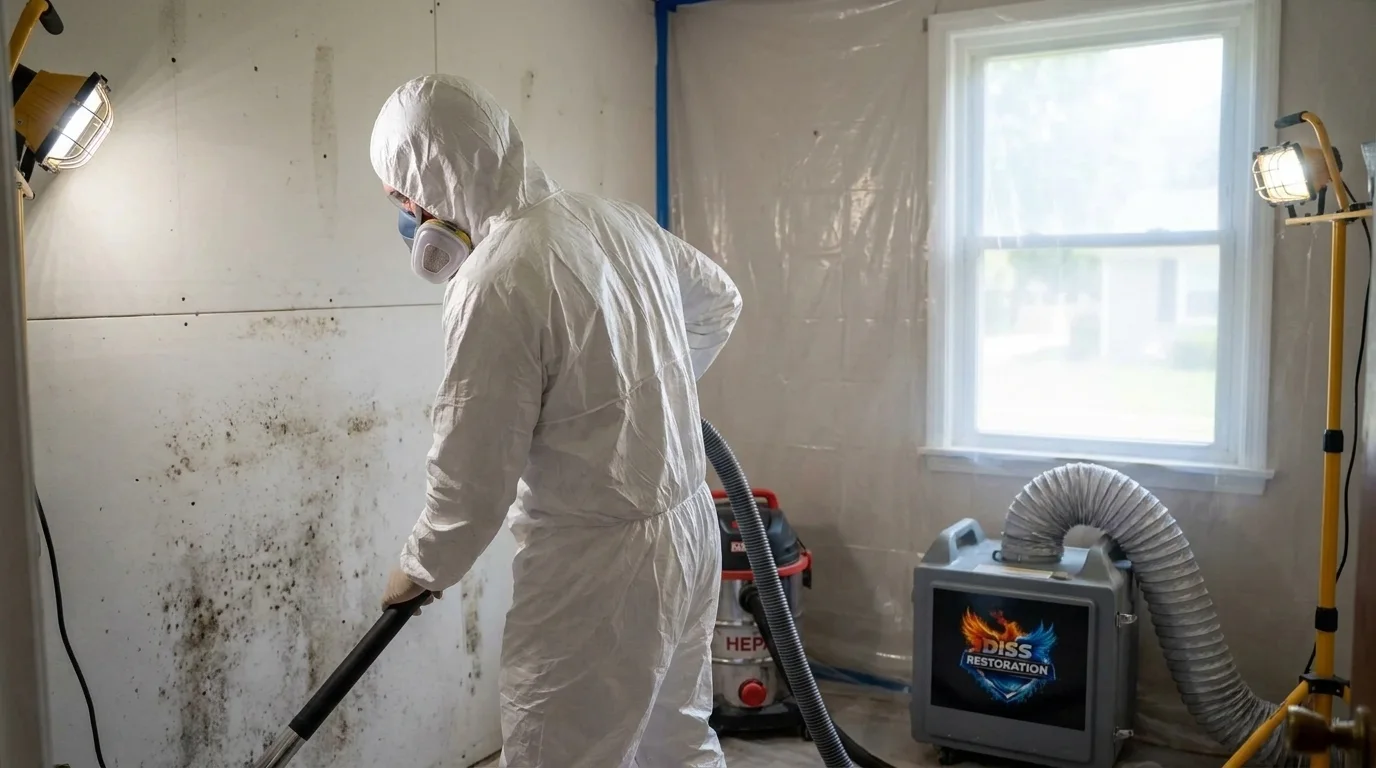
Once the scope is mapped, the crew establishes containment using 6-mil poly barriers and negative air pressure with HEPA-filtered air scrubbers. This keeps spores from migrating to unaffected rooms during removal, a step that matters especially in the open floor plans common to Austintown’s split-level designs, where a single uncontained breach can spread contamination across multiple living areas.
Affected porous materials, drywall, insulation, wood trim, are removed and bagged for disposal per Ohio EPA guidelines. Structural framing that can be saved is HEPA-vacuumed, treated with an EPA-registered antimicrobial, and dried to verified moisture levels before any reconstruction begins. The team documents conditions before, during, and after for insurance carriers.
Reaching Austintown from Youngstown
DISS Restoration operates out of Youngstown, which puts Austintown well within a short drive, typically via US-62 or Mahoning Avenue depending on the address and time of day. Because the team is available around the clock, a call at 2 a.m. after a sump pump failure gets the same response as a call on a Tuesday afternoon. Mold remediation itself is a multi-day process, but getting eyes on the moisture source quickly is what limits how far the damage spreads.
Austintown Insurance Coordination
Whether mold is the result of a covered peril, a burst pipe, a storm-driven roof leak, or a long-term moisture issue, documentation is what drives a successful claim. The crew photographs and measures all affected materials, notes moisture readings at multiple points, and provides a written scope that adjusters and carriers can work from directly. DISS Restoration bills most major carriers and can communicate with your adjuster throughout the project so you’re not managing that back-and-forth on top of the disruption at home.
Local Note
A pattern worth knowing in Austintown: many of the township’s mid-century homes were built with minimal attic ventilation by today’s standards, small soffit vents and a single ridge vent that doesn’t move enough air in humid months. When a bathroom exhaust fan terminates into the attic instead of through the roof (a common DIY shortcut in older homes), warm moist air condenses on the cold roof sheathing every winter. The mold that results often goes undetected for years because the attic isn’t a space homeowners check regularly. If you’re seeing musty odors on the upper floor but no visible mold in living spaces, the attic is the first place worth inspecting.
If mold is affecting your Austintown home or rental property, call DISS Restoration at (724) 981-1441. The team is available 24/7, and the sooner containment goes up, the less material typically needs to come out.
Serving Austintown from our Youngstown headquarters — ★ 4.7 · 63 Google reviews
“This restoration company was able to take our weather related water intrusion job from start to finish within a very reasonable timeframe. The people we worked with communicated their next steps and asked questions when needed. The construction manager was always super quick to respond to my…” — Debbie, September 2026Read our reviews on Google →
Mold Remediation in Austintown: Service Coverage
Frequently Asked Questions
How fast can you arrive for mold remediation in Austintown?
How quickly can DISS Restoration reach Austintown for a mold emergency?
Are Austintown's older split-level and ranch homes more vulnerable to hidden mold growth?
Does Mahoning County's clay soil affect mold risk in Austintown basements?
What does the mold containment process actually involve, and why does it matter in open floor plans?
Will my homeowner's insurance cover mold remediation in Austintown, and how does DISS handle the claim?
Mold Remediation response in Austintown
Most Austintown calls see a technician on-site within 60 minutes from our Youngstown headquarters.