Mold Remediation in Youngstown
24/7 mold remediation in Youngstown and surrounding areas. IICRC-certified, insurance billing accepted. Call (724) 981-1441.
That musty smell in the basement that won’t go away after a pipe leak. The dark staining creeping along drywall behind a water heater. The allergic symptoms that started after a slow roof leak went unnoticed for weeks. Mold doesn’t announce itself, it colonizes quietly, and by the time it’s visible, the colony is almost always larger than what you can see. Within 24 to 48 hours of a moisture event, spores can begin to take hold in porous building materials. Left alone, they spread through wall cavities, HVAC ducts, and subfloor assemblies in ways that a coat of paint or a bleach wipe will never fix.
What mold remediation actually involves
Mold remediation is not mold removal in the sense of scrubbing a surface. It is a controlled process of containing active growth, physically removing colonized materials, cleaning residual spore contamination from surrounding surfaces and air, and verifying through post-remediation testing that the affected space has returned to normal fungal ecology.
The work is governed by the IICRC S520 Standard for Professional Mold Remediation, and DISS Restoration holds the IICRC AMRT (Applied Microbial Remediation Technician) certification, meaning the people doing the work have been trained specifically in mold science, containment engineering, and remediation protocols, not just general cleanup.
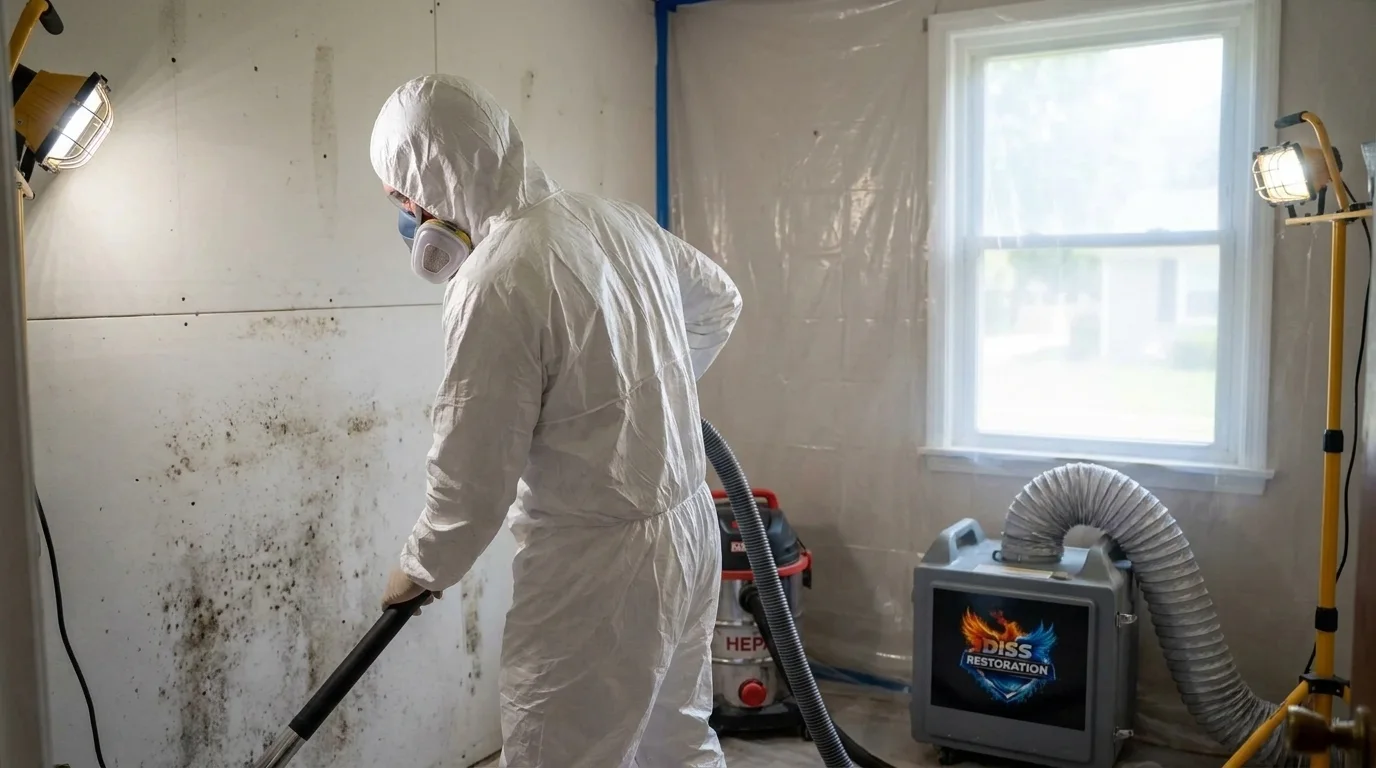
Equipment on a mold job looks different from a water damage job. Negative air machines with HEPA filtration run continuously inside the containment zone, keeping airborne spore counts from migrating to clean areas of the structure. Air scrubbers cycle the air inside containment multiple times per hour. Technicians work in full PPE, respirators rated for mold exposure, disposable suits, and gloves, because disturbing a mold colony releases spores into the air in concentrations far above what the space normally holds.
Timeline depends on the scope. A single affected room with limited material removal can be completed in one to three days. Larger losses involving multiple building cavities, HVAC contamination, or significant structural material removal take longer, and rushing the containment or clearance steps creates liability for everyone involved.
Our process
-
Assessment and moisture mapping. Before any material comes out, technicians identify the moisture source and map the full extent of affected areas using thermal imaging and moisture meters. Mold follows moisture, and moisture in wall cavities doesn’t show on the surface. This step determines the remediation scope and informs the containment design.
-
Containment installation. Affected areas are isolated with poly sheeting, sealed at seams and penetrations, and placed under negative air pressure. This keeps disturbed spores from cross-contaminating adjacent rooms, HVAC systems, or personal belongings. The size and configuration of containment is determined by the S520 standard based on the affected square footage and material types involved.
-
Removal of colonized materials. Porous materials, drywall, insulation, wood framing with surface penetration, that cannot be cleaned to an acceptable standard are removed, double-bagged in poly, and disposed of properly. Non-porous surfaces are HEPA-vacuumed and wiped with EPA-registered antimicrobial agents. The goal is physical removal of the colony, not chemical suppression of it.
-
HEPA air filtration and surface cleaning. Negative air machines and air scrubbers run throughout the remediation and for a defined period after material removal. All surfaces inside containment, including framing, subfloor, and mechanical components, are cleaned and treated before containment is removed.
-
Post-remediation verification (clearance testing). An independent third-party air quality test, not performed by the remediation contractor, confirms that spore counts inside the remediated space are within normal range compared to outdoor baseline samples. DISS Restoration does not release containment or sign off on a job as complete without clearance. This protects you, and it protects the integrity of any insurance claim.
What separates a good mold response from a bad one
The most common failure in mold remediation is inadequate containment, either skipping it entirely on “small” jobs or building it without negative air pressure. Without negative pressure, disturbing the mold colony pushes spores into the rest of the structure. A job that starts as a bathroom wall can become a whole-house air quality problem.
The second most common failure is treating mold as a surface issue. Bleach kills surface cells on non-porous materials but does not penetrate into drywall paper, wood grain, or insulation. Painting over visible growth is not remediation, it is concealment, and insurance adjusters are trained to identify it during reinspection.
Insurance adjusters and industrial hygienists also look for a documented chain of custody: a written scope of work before remediation begins, photographs of affected materials before and after removal, a waste disposal record, and a clearance test report from an independent tester. Without that documentation, a carrier has grounds to dispute the claim or require re-remediation.
Finally, the moisture source must be corrected before remediation begins. Remediating an active leak is not remediation, it is temporary cleanup that will fail within weeks.
What does mold remediation cost?
Typical costs vary significantly based on the size of the affected area, the types of materials involved, and whether the moisture source has already been addressed. Most homeowners pay somewhere in the ranges below for professional, containment-compliant remediation, these are industry-typical figures, not DISS Restoration quotes.
| Scenario | Typical range |
|---|---|
| Single surface area, limited material removal (< 10 sq ft) | $500 – $1,500 |
| Single room, moderate drywall and insulation removal | $1,500 – $4,000 |
| Crawl space remediation | $2,000 – $6,000 |
| Basement with structural material involvement | $3,500 – $10,000 |
| Multi-room or HVAC system contamination | $6,000 – $20,000+ |
Every loss is different, and DISS Restoration provides a written scope of work before any remediation begins so you know exactly what is being done and why. Homeowners insurance typically covers mold remediation when the mold resulted from a covered sudden and accidental loss, such as a burst pipe, but policies vary widely on mold sublimits and exclusions, which is why documentation of the originating event matters from day one.
Seasonal and regional considerations
Youngstown and the surrounding Mahoning Valley sit in a climate that creates mold risk in multiple seasons. Humid summers push indoor relative humidity above the 60% threshold where mold growth accelerates, particularly in homes with older basement waterproofing or crawl spaces without vapor barriers. Winters bring freeze-thaw cycles that stress older masonry foundations, common in the region’s pre-war and mid-century housing stock, allowing water infiltration that goes undetected until mold is already established.
Many homes in the area have plaster-and-lath construction, which holds moisture differently than modern drywall. Plaster can read dry at the surface while the lath behind it stays saturated for weeks after a leak, providing a concealed growth environment that standard visual inspection misses. Thermal imaging and deep-probe moisture meters are not optional on these structures, they are how you find the actual extent of the problem.
Service area
DISS Restoration is based in Youngstown, OH and provides mold remediation throughout the Mahoning Valley and surrounding communities, including Boardman, Canfield, Warren, Niles, Austintown, Struthers, and into western Pennsylvania. City-specific pages detail local considerations for each area and link back here for the full remediation process.
If you are seeing visible mold growth, smelling persistent musty odors, or dealing with the aftermath of a water loss that wasn’t fully dried, call (724) 981-1441 to request an air quality assessment. The sooner the moisture source and affected materials are evaluated, the smaller the remediation scope, and the lower the cost.
Services We Handle
- Attic Mold Removal
- Basement Mold Removal
- Bathroom Mold Removal
- Black Mold Removal
- Crawl Space Mold Removal
- Emergency Mold Removal
- Mold Removal Behind Walls
- Water Damage Mold Removal
Frequently Asked Questions
Does homeowners insurance cover mold remediation?
What level of mold contamination requires full containment under the IICRC S520 standard?
What is post-remediation verification, and why does it matter?
Can mold come back after professional remediation?
What should I do — and not do — while waiting for a mold assessment?
Looking for the best mold remediation company in Youngstown?
DISS Restoration provides mold remediation in Youngstown, OH and the surrounding area, and has served local property owners since 2021. Customers rate us 4.7 out of 5 stars across 63 Google reviews. We answer calls 24/7 — call (724) 981-1441 for immediate help.
Need Mold Remediation now?
We respond 24/7 across Youngstown and surrounding OH cities.
Related Coverage
- Our Restoration Services
- Contact DISS Restoration
- Mold Remediation in Austintown
- Mold Remediation in Boardman
- Mold Remediation in Canfield
- Mold Remediation in Girard
- Mold Remediation in Hubbard
- Mold Remediation in Niles
- Mold Remediation in Struthers
- Mold Remediation in Warren
- How To Choose a Restoration Company in Youngstown (Without Getting Burned)
- How To Test for Mold in Your Home (DIY Kits vs a Pro Inspection)
- 7 Signs You Have Hidden Mold (and What To Do Next)