24/7 Emergency Storm Damage Restoration in Youngstown
24/7 emergency storm damage restoration in Youngstown and surrounding areas. IICRC-certified, insurance billing accepted. Call (724) 981-1441.
Storm damage emergency in Youngstown? We answer 24/7. Call now and our crew heads out to secure the property and stop further damage.
A storm doesn’t announce when it’s finished damaging your home. The obvious destruction, a tree through the roof, a shattered window, siding peeled back to bare sheathing, is only the beginning. Within hours, wind-driven rain soaks into wall cavities, attic insulation, and subfloor decking. Within days, that hidden moisture becomes a mold problem. The clock starts the moment the storm passes, and the window for limiting secondary damage is narrow.
What Storm Damage Restoration actually involves
Storm damage restoration is not a single trade, it’s a coordinated sequence of emergency stabilization, structural drying, and repair work that has to happen in the right order. Skipping ahead to repairs before moisture is fully extracted means trapping water inside finished assemblies, where it will rot framing and feed mold colonies behind new drywall.
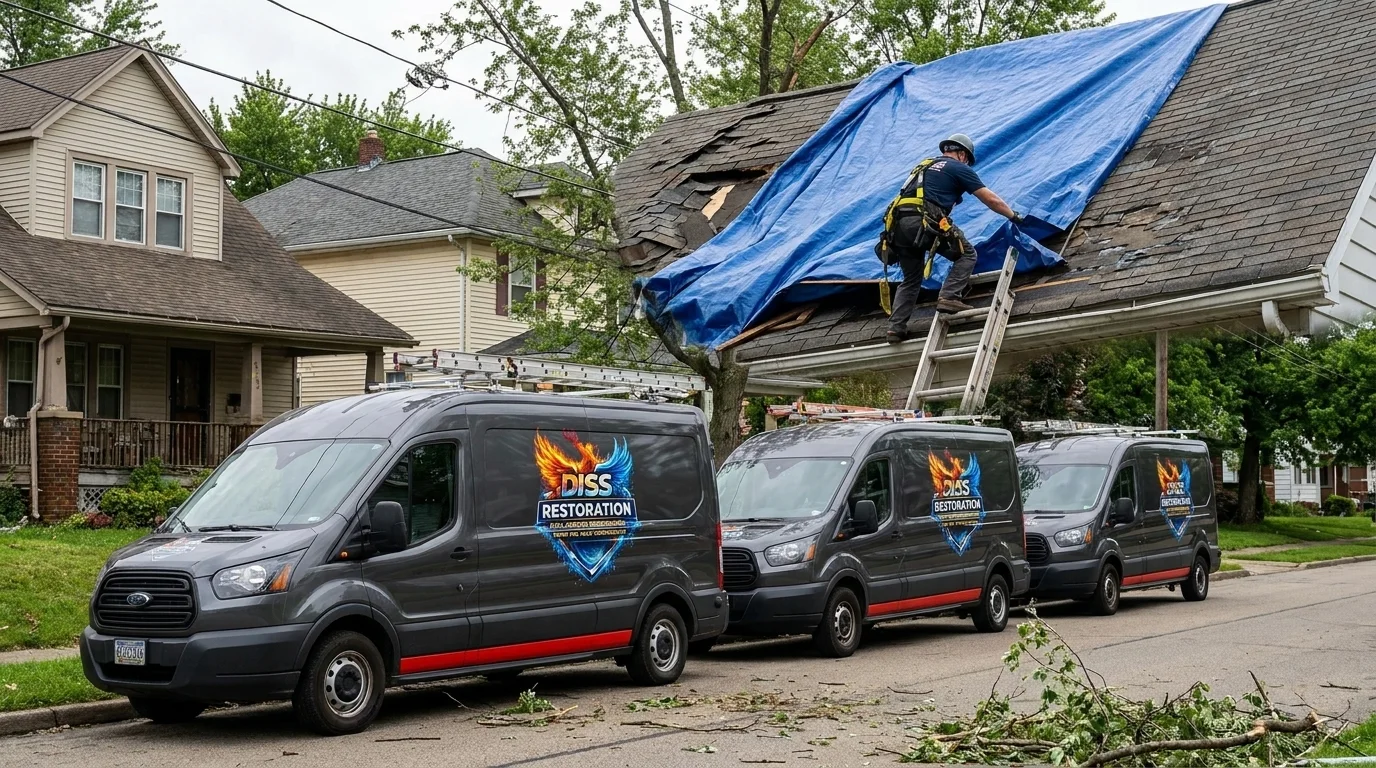
The work typically begins with emergency tarping and board-up to stop the weather from continuing to enter the structure. From there, the focus shifts to water intrusion: mapping where rain entered, tracing its migration path through building materials, and extracting standing water before it wicks further. Industrial-grade desiccant or refrigerant dehumidifiers, high-velocity air movers, and thermal imaging cameras are standard equipment for this phase. Structural drying is monitored daily with calibrated moisture meters until affected materials reach documented drying goals, not just until they feel dry to the touch.
Once the structure is dry and stabilized, the scope shifts to physical repair: replacing damaged roofing, siding, windows, insulation, drywall, and any structural members compromised by impact or prolonged saturation. In older Youngstown-area homes, many built in the mid-20th century with plaster-and-lath walls and older roof decking, the repair scope often differs significantly from what a quick visual inspection suggests.
Our process
-
Emergency stabilization, Tarping breached roof sections, boarding compromised windows and doors, and securing any structural hazards before the crew moves inside. This step protects both the structure and the people working in it.
-
Damage mapping and moisture intrusion assessment, A systematic inspection using thermal imaging and calibrated moisture meters to document every point of water entry and trace its migration into walls, ceilings, floors, and framing. This produces the documentation that drives both the drying plan and the insurance claim.
-
Water extraction and structural drying, Standing water is extracted first; then drying equipment is positioned according to a psychrometric drying plan. Readings are logged daily. Drying is not complete until affected assemblies reach the moisture content targets defined by the IICRC S500 standard, a number, not a feeling.
-
Debris removal and structural repair, Damaged roofing materials, insulation, drywall, and compromised framing are removed and documented before replacement begins. Repair work is sequenced so that concealed cavities are fully dry before they’re closed in.
-
Final inspection and documentation package, A close-out inspection confirms moisture readings are within normal range throughout the structure. The complete documentation package, photos, moisture logs, scope of work, and receipts, is compiled for the insurance carrier.
What separates a good storm damage response from a bad one
The most common failure in storm damage restoration is treating it like a roofing or general contracting job. A contractor who patches the roof and replaces the wet drywall without drying the wall cavity first is creating a future mold problem inside a finished wall. By the time that problem surfaces, the warranty period is long past.
A few specific things experienced operators do differently:
- Thermal imaging before demolition. Infrared cameras reveal moisture migration that moisture meters alone miss, particularly in plaster walls, cathedral ceiling assemblies, and around chimney chases, which are common failure points in northeastern Ohio’s older housing stock.
- Documenting drying progress, not just completion. Insurance adjusters and building inspectors want to see daily moisture logs, not a single final reading. Carriers increasingly require this documentation to approve structural drying line items.
- Identifying wind-driven rain versus bulk water intrusion. The two behave differently inside a wall assembly. Wind-driven rain can saturate insulation and sheathing while the interior drywall reads nearly dry, a pattern that leads to missed damage and underpaid claims.
- Checking for pre-existing damage. Adjusters are trained to identify damage that predates the storm event. A thorough pre-repair photo and moisture documentation package protects the homeowner’s claim from being partially denied on those grounds.
Our team holds IICRC certifications in Water Restoration (WRT), Applied Structural Drying (ASD), and Fire and Smoke Restoration (FSRT), relevant because many storm events involve both wind damage and electrical or fire hazards, and we are an EPA Lead-Safe Certified Firm, which matters in Youngstown-area homes built before 1978.
What does Storm Damage Restoration cost?
Typical costs vary widely depending on the size of the breach, how long water was entering before mitigation began, and the construction type of the home. Most homeowners pay somewhere in the ranges below, which reflect industry-typical figures, not a quote from DISS Restoration.
| Scenario | Typical industry range |
|---|---|
| Minor roof breach, limited interior water intrusion | $2,500 – $6,000 |
| Single room with significant water damage and drying | $4,000 – $10,000 |
| Tree impact with structural damage, partial roof loss | $12,000 – $35,000 |
| Whole-house wind and water event, major repairs | $30,000 – $80,000+ |
| Emergency tarping and board-up only | $500 – $2,500 |
| Mold remediation triggered by delayed storm response | $3,500 – $15,000 |
Every loss is different, and DISS Restoration provides a written scope of work before any work begins. Homeowners insurance typically covers sudden and accidental storm damage, wind, hail, falling trees, and resulting water intrusion, though flood damage from ground-level water generally requires a separate flood policy.
Seasonal and regional considerations
Northeastern Ohio sits in a weather corridor that produces severe thunderstorms from late spring through early fall, with the highest-intensity events typically arriving in June and July. Lake Erie’s proximity amplifies storm systems that track across the region, and the Mahoning Valley’s terrain can funnel wind in ways that concentrate damage in specific corridors.
Winter ice storms create a separate damage pattern: ice dams along roof edges force meltwater under shingles and into attic assemblies, often without any visible interior sign until the ceiling is already saturated. Freeze-thaw cycles also stress older masonry and flashing details common in Youngstown’s mid-century housing stock, creating entry points that a summer storm can exploit.
Because DISS Restoration operates 24/7, we respond to both the summer severe-weather season and winter ice events, the two peaks that drive the majority of storm damage calls in this region.
Service area
DISS Restoration is based in Youngstown and serves the broader Mahoning Valley and surrounding communities, including Warren, Boardman, Austintown, Canfield, Niles, Girard, Hubbard, and into Trumbull and Columbiana counties. The city-specific pages linked from this service cover storm damage restoration in each of those communities in more detail.
If a storm has left your home exposed or you’re watching a water stain spread across a ceiling, call (724) 981-1441 now. Our team will begin emergency stabilization, document the damage for your insurance carrier, and put a drying plan in place before secondary damage compounds the loss. Start your storm damage assessment today.
Services We Handle
- Emergency Storm Damage Repair
- Hurricane Damage Restoration
- Storm & Wind Damage Restoration
- Wind Damage Repair
- Wind Damage Restoration
Frequently Asked Questions
Does homeowners insurance cover storm damage restoration?
What should I do immediately after storm damage before the restoration crew arrives?
How do you find water damage inside walls that isn't visible from the surface?
How long does structural drying take after storm-related water intrusion?
What storm damage gets missed most often, and how does it affect my insurance claim?
Looking for the best storm damage restoration company in Youngstown?
DISS Restoration provides storm damage restoration in Youngstown, OH and the surrounding area, and has served local property owners since 2021. Customers rate us 4.7 out of 5 stars across 63 Google reviews. We answer calls 24/7 — call (724) 981-1441 for immediate help.
Need Storm Damage Restoration now?
We respond 24/7 across Youngstown and surrounding OH cities.
Related Coverage
- Our Restoration Services
- Contact DISS Restoration
- 24/7 Emergency Storm Damage Restoration in Austintown
- 24/7 Emergency Storm Damage Restoration in Boardman
- 24/7 Emergency Storm Damage Restoration in Canfield
- 24/7 Emergency Storm Damage Restoration in Girard
- 24/7 Emergency Storm Damage Restoration in Hubbard
- 24/7 Emergency Storm Damage Restoration in Niles
- 24/7 Emergency Storm Damage Restoration in Struthers
- 24/7 Emergency Storm Damage Restoration in Warren