
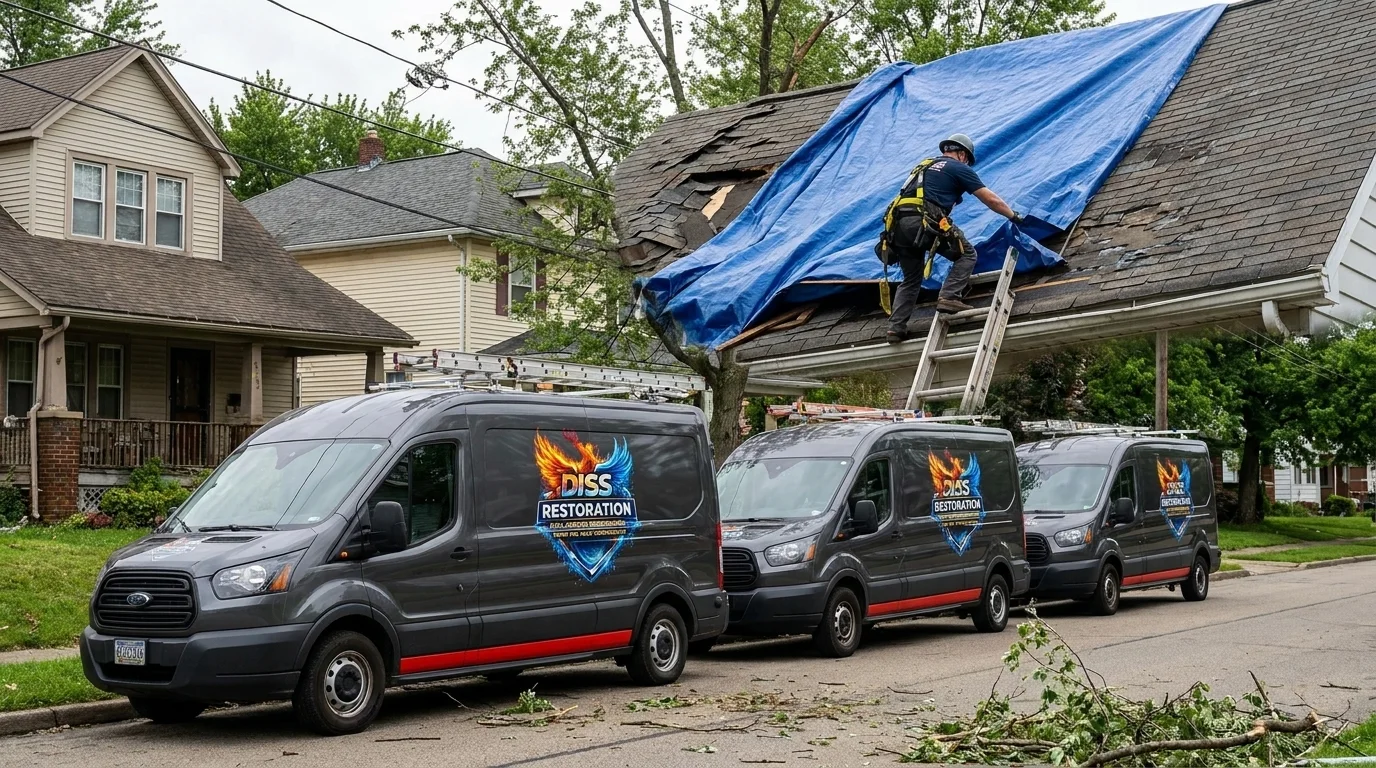
24/7 Emergency Storm Damage Restoration in Austintown
24/7 emergency storm damage restoration in Austintown, OH. IICRC-certified, insurance billing accepted. Call (724) 981-1441.
Our IICRC-certified technicians are dispatched from our Youngstown, OH headquarters and are typically on-site in Austintown within 60 minutes of your call.
Austintown sits in the heart of the Mahoning Valley, where late-spring and summer storm systems rolling off Lake Erie can stack up fast, producing the kind of straight-line winds, hail, and sudden downpours that leave roofs open to the sky and basements filling before the thunder stops. When that happens, the clock starts immediately: water behind siding, debris punching through attic sheathing, and saturated insulation that won’t show its full damage until days later. DISS Restoration responds 24/7 from Youngstown to help Austintown property owners stop the loss before it compounds.
Why Austintown Properties See Significant Storm Damage
Mahoning County’s position in northeastern Ohio puts it squarely in a corridor that sees both lake-effect weather systems in winter and severe convective storms in the warmer months. Austintown’s housing stock reflects decades of post-war residential development, a large share of homes here were built between the late 1940s and the 1970s, meaning many have original roof decking, older asphalt shingles with limited wind ratings, and wood-framed soffits that can fail quickly under hail impact or sustained gusts.
That construction era also means a lot of homes have crawl spaces or slab-on-grade foundations that are vulnerable to the rapid surface runoff that follows a hard storm on Mahoning County’s clay-heavy soils. Clay doesn’t absorb water quickly, it sheds it toward foundations, window wells, and basement walls. A two-inch rain event that would drain away in sandier terrain can push water into a finished basement here within the hour.
Tornado watches and warnings are not uncommon for this part of Ohio in spring and early summer. Even storms that don’t produce confirmed tornadoes can generate microburst winds capable of dropping large trees onto structures, and tree damage to a roof creates an immediate interior exposure that worsens with every subsequent rain.
Our Storm Damage Restoration Process in Austintown
The first priority after any storm event is stopping further damage. That means tarping compromised rooflines, boarding broken windows and doors, and extracting any standing water before it migrates into wall cavities or subfloor assemblies. Our IICRC-certified team uses thermal imaging and moisture meters to map exactly where water has traveled, not just where it’s visible.
From there, the process moves into structural drying calibrated to actual conditions in the structure. Older homes common in Austintown often have plaster walls over wood lath rather than modern drywall. Plaster is dense and slow to release moisture, it can read near-normal at the surface while the lath and framing behind it remain saturated. We adjust drying equipment placement and run times accordingly rather than relying on surface readings alone.
Debris removal, temporary weatherproofing, and documentation for your insurance claim happen in parallel. Every affected material is photographed, measured, and logged, the kind of thorough documentation that supports a complete claim rather than a partial settlement.
Reaching Austintown from Youngstown
DISS Restoration is based in Youngstown, making Austintown one of our closest service areas. The drive west on US-422 or Mahoning Avenue puts our crew on-site quickly, and because we operate 24/7, a storm that hits at 2 a.m. gets the same response as one that hits at noon. If you’re dealing with a tree through your roof or a flooded basement in the middle of the night, call (724) 981-1441 and we’ll dispatch immediately.
Austintown Insurance Coordination
Most homeowners’ policies cover sudden storm damage, wind, hail, falling trees, but the documentation requirements matter enormously. Carriers want to see the scope of damage established before repairs begin, and they want evidence that mitigation steps were taken promptly to prevent secondary damage. We photograph and document every affected area before we touch it, provide a written scope of work, and communicate directly with adjusters to keep the claim moving. If your policy includes an ALE (additional living expense) provision and the home is uninhabitable, we can help you understand what to request from your carrier.
Local Note
Homes in Austintown built during the 1950s and 1960s frequently have attached garages with flat or low-slope rooflines, a design that was popular in this part of Ohio during that era. Those roof sections are disproportionately vulnerable to hail damage and debris accumulation because water doesn’t shed as readily as on a pitched surface. After a significant storm, it’s worth having those sections inspected even if the main roofline looks intact, because a slow leak into the garage ceiling can travel laterally into the wall shared with the living space before it becomes visible.
If you’ve had storm damage, or you’re not sure whether what you’re seeing is damage, call DISS Restoration at (724) 981-1441. We serve Austintown and the surrounding Mahoning County area around the clock, and we’ll give you a straight assessment of what needs to happen next.
Serving Austintown from our Youngstown headquarters — ★ 4.7 · 63 Google reviews
“This restoration company was able to take our weather related water intrusion job from start to finish within a very reasonable timeframe. The people we worked with communicated their next steps and asked questions when needed. The construction manager was always super quick to respond to my…” — Debbie, September 2026Read our reviews on Google →
Storm Damage Restoration in Austintown: Service Coverage
Frequently Asked Questions
How fast can you arrive for storm damage restoration in Austintown?
How quickly can DISS Restoration reach Austintown after a storm?
Austintown has a lot of older homes — does that affect how storm damage restoration is handled?
Does Mahoning County's clay soil make storm flooding worse for Austintown properties?
A tree fell on my Austintown home — what should I do before your crew arrives?
Will my homeowner's insurance cover storm damage restoration in Austintown, and how does the claims process work?
Storm Damage Restoration response in Austintown
Most Austintown calls see a technician on-site within 60 minutes from our Youngstown headquarters.