
24/7 Emergency Storm Damage Restoration in Canfield
24/7 emergency storm damage restoration in Canfield, OH. IICRC-certified, insurance billing accepted. Call (724) 981-1441.
Our IICRC-certified technicians are dispatched from our Youngstown, OH headquarters and are typically on-site in Canfield within 60 minutes of your call.
Mahoning County sits in a corridor where late-season cold fronts collide with residual Great Lakes moisture, and Canfield, tucked in the township’s rolling terrain, takes the full force of that combination. Severe thunderstorms in summer, ice storms in late fall, and the occasional tornado-warned supercell in spring can strip shingles, drop mature oaks across rooflines, and push water through wall assemblies faster than most homeowners realize. When that happens, DISS Restoration responds, 24 hours a day, from its Youngstown base.
Why Canfield Properties See Significant Storm Damage
Canfield’s housing stock skews toward mid-century ranch and two-story colonial construction, with a meaningful share of homes built in the 1950s through 1970s. Those decades predate modern roof decking standards and the widespread use of hurricane straps or ring-shank nails. A 60-mph straight-line wind event, common in Mahoning County during summer convective storms, can lift tab shingles or peel back older three-tab sections, leaving roof decking exposed within minutes. Once the decking is wet, water migrates along rafter tails and into wall cavities before a single interior ceiling stain appears.
The township’s mature tree canopy is an asset in calm weather and a liability in storms. Large oaks and silver maples that shade Canfield’s residential streets have root systems that can be compromised by wet soil after heavy rain, making wind-throw more likely than in areas with younger or smaller trees. A tree strike on a roof is not just a structural problem, it opens the envelope to rain intrusion, and every hour the interior stays exposed accelerates secondary damage to insulation, framing, and finished surfaces.
Our Storm Damage Restoration Process in Canfield
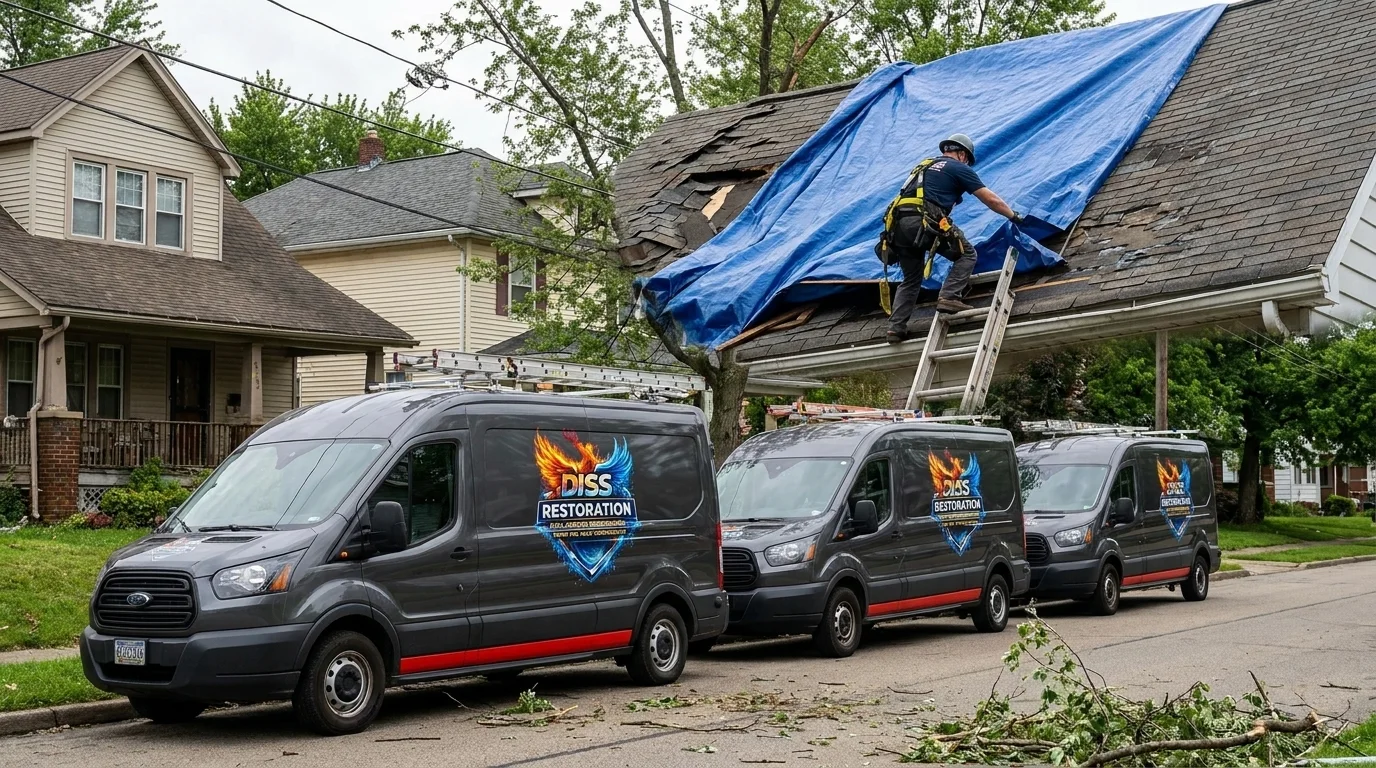
The first priority after a storm strike is stopping ongoing intrusion. Our crews carry roof tarps, plywood, and fasteners to every storm call so emergency board-up and weatherproofing happen on the same visit as the initial assessment, not a day later when a second crew can be scheduled.
Once the building envelope is secured, the process shifts to documentation and moisture mapping. We use thermal imaging and calibrated moisture meters to trace water migration through wall assemblies and subflooring, because storm-driven rain rarely stops where it enters. Water that enters through a soffit can travel horizontally along a top plate and appear in a first-floor wall cavity two rooms away. That full picture matters for accurate scope development and for the insurance adjuster reviewing your claim.
Structural drying follows IICRC S500 and S520 protocols, equipment is placed based on psychrometric readings, not by room count. Daily monitoring logs document drying progress, which carriers require before authorizing reconstruction. Our IICRC-certified team holds credentials in Water Damage Restoration, Structural Drying, and Applied Microbial Remediation, so if mold colonization has already begun in a cavity that stayed wet before the storm was reported, we can address it under the same mobilization.
Reaching Canfield from Youngstown
DISS Restoration operates out of Youngstown, and Canfield is a direct run south on US-62 or via Mahoning Avenue to State Route 446. The routes are straightforward in most conditions, though late-season ice storms that trigger storm damage calls can also slow travel on township roads. We dispatch 24/7 and communicate an estimated arrival window when you call, (724) 981-1441, so you know when to expect the crew rather than waiting without information.
Working with Insurance After a Canfield Storm
Most storm damage claims in Ohio are filed under the dwelling coverage section of a homeowner’s policy, with wind and hail typically covered as named perils. The documentation we produce, moisture maps, thermal images, itemized scope, is formatted to align with what adjusters and desk reviewers expect to see. We communicate directly with your carrier throughout the process and can meet an adjuster on-site if your policy requires an in-person inspection before work begins.
One practical note for Canfield homeowners: Ohio does not cap the number of roof claims a carrier can use to non-renew a policy the way some states do, so it is worth reviewing your policy terms before filing if the damage is borderline. We can help you assess scope honestly so you make an informed decision.
Local Note
Canfield’s township roads and cul-de-sac developments can present staging challenges after a major storm, particularly when downed branches or utility crews are already working in the right-of-way. Our crews call ahead to assess access before arrival and carry equipment that can be hand-carried from a street-parked position when a driveway is blocked, something that comes up more than you’d expect after a significant wind event moves through the area. If AEP Ohio has a crew working a nearby pole, we coordinate around their timeline rather than competing for the same access point.
Serving Canfield from our Youngstown headquarters — ★ 4.7 · 63 Google reviews
“We called DISS Restoration to remediate a flooded basement. They came out within an hour of getting called to assess the situation. Immediate action was then taken to remove the water, tear out carpets, dry the basement and treat the basement for any mold. They used a slew of people for all of…” — Jeff, July 2026Read our reviews on Google →
Storm Damage Restoration in Canfield: Service Coverage
Frequently Asked Questions
How fast can you arrive for storm damage restoration in Canfield?
How quickly can DISS Restoration reach Canfield after a storm?
Canfield has a lot of older homes — does that affect how storm water damage is dried?
A tree came through my roof during a Canfield storm — where do you start?
Will my Ohio homeowner's insurance cover storm damage repair in Canfield?
How long does storm damage restoration typically take for a Canfield home?
Storm Damage Restoration response in Canfield
Most Canfield calls see a technician on-site within 60 minutes from our Youngstown headquarters.