24/7 Emergency Water Damage Restoration in Canfield
24/7 emergency water damage restoration in Canfield, OH. IICRC-certified, insurance billing accepted. Call (724) 981-1441.
Our IICRC-certified technicians are dispatched from our Youngstown, OH headquarters and are typically on-site in Canfield within 60 minutes of your call.
Canfield sits in Mahoning County’s glacially flattened terrain, where heavy clay soils shed water slowly and spring snowmelt has nowhere fast to go. When a pipe lets go at 2 a.m. or a sump pump quits during an April storm, that standing water doesn’t just soak the carpet, it migrates under hardwood, wicks into wall cavities, and starts the clock on secondary damage before most people realize how far it’s traveled. DISS Restoration responds 24/7 from Youngstown and brings IICRC-certified water damage restoration to Canfield properties before that clock runs out.
Why Canfield Properties See Water Damage Issues
Mahoning County’s clay-heavy glacial till is the underlying factor most homeowners never think about until they have a wet basement. Clay doesn’t drain, it holds moisture against foundation walls, and when hydrostatic pressure builds after a sustained rain or a rapid thaw, block foundations common in Canfield’s mid-century residential neighborhoods can bow inward or allow seepage through mortar joints. The township’s mix of older ranch-style homes and split-levels means many crawl spaces and lower levels sit at or near the water table during wet seasons.
Canfield’s winters compound the problem. Freeze-thaw cycles, sometimes multiple times in a single week during January and February, stress supply lines in uninsulated exterior walls and garage utility runs. Copper and galvanized pipe that has been in service for decades is especially vulnerable. A pinhole leak behind a finished wall can go undetected for weeks, and by the time a homeowner notices a soft spot in the drywall or a musty smell, moisture has already colonized the wall cavity.
Our Water Damage Restoration Process in Canfield
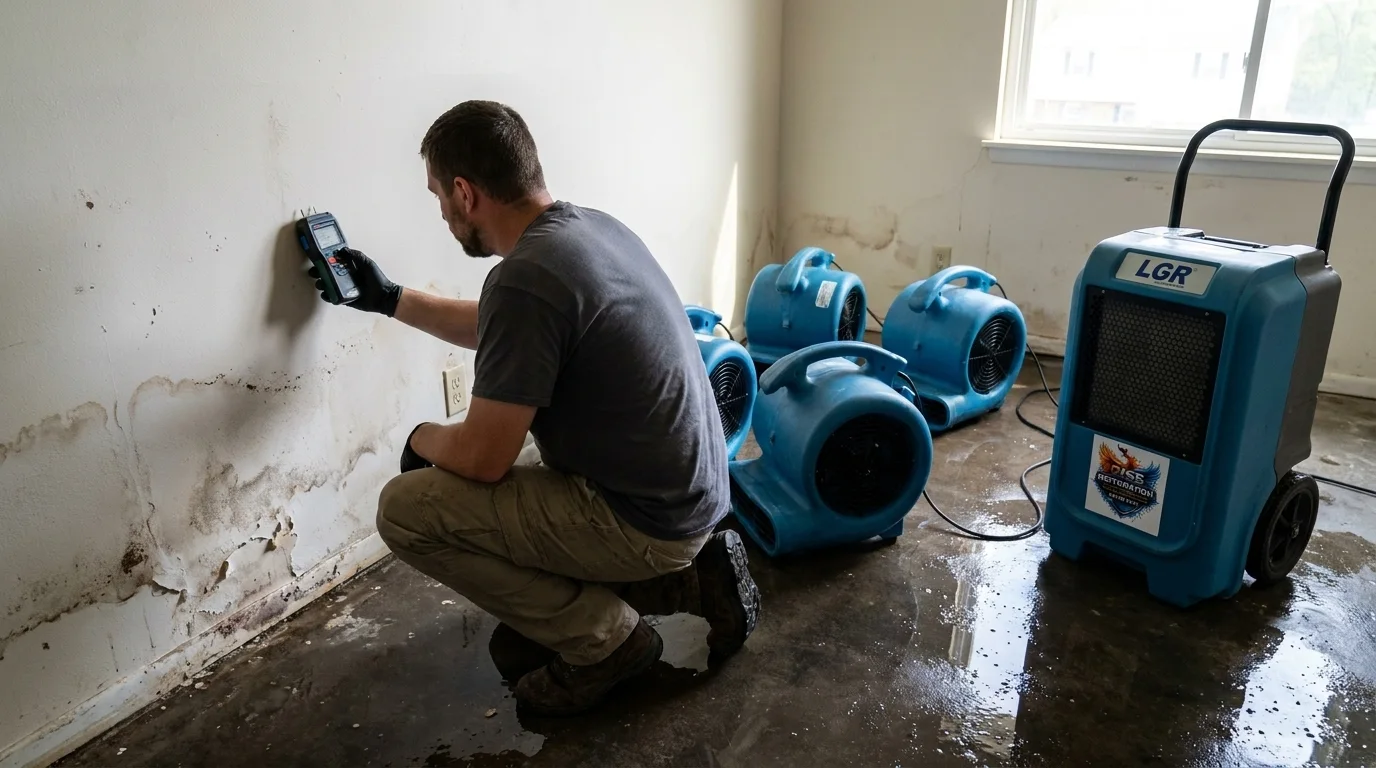
Every job starts with a full moisture mapping inspection, thermal imaging and calibrated moisture meters on walls, subfloor, and ceiling assemblies, so we know exactly where water traveled, not just where it pooled. We don’t guess at drying boundaries; we document them.
From there, the process moves through five concrete stages:
- Water extraction, truck-mounted and portable extractors pull standing water from hard floors, carpet, and subfloor assemblies. In Canfield’s split-level homes, where lower-level family rooms often have carpet over concrete slab, we use weighted extraction heads to pull moisture that a standard wand leaves behind.
- Controlled demolition, saturated drywall, insulation, and flooring that cannot be dried in place are removed to the documented wet line. We photograph every cut before and after for your insurance carrier.
- Structural drying, commercial desiccant and refrigerant dehumidifiers, high-velocity air movers, and in-wall drying panels run in a closed system calibrated to the specific volume and material composition of each affected space. Drying targets follow the IICRC S500 standard.
- Daily monitoring, a technician checks moisture readings each day and adjusts equipment placement until every reading reaches the dry standard. We don’t pull equipment early.
- Clearance documentation, final moisture readings are logged and provided to you and your adjuster before any reconstruction begins.
Reaching Canfield from Youngstown
DISS Restoration’s Youngstown base puts Canfield within a straightforward drive south on US-62 through Boardman, or via I-680 to OH-224 east, routes our crews run regularly regardless of the hour. Because we operate 24/7, a call at midnight gets the same dispatch as a call at noon. We stage equipment in the truck before we leave, so extraction starts when we arrive, not after a second trip.
Canfield Insurance Coordination
Water damage claims in Ohio require clear documentation from the first hour, carrier adjusters want to see moisture readings, photo logs of affected materials, and a scope of work before authorizing demolition. We build that file as we work, not after the fact. Our technicians photograph each affected room, document moisture meter readings by location, and provide a written scope formatted for direct submission to your carrier. If your adjuster needs to walk the site, we schedule around that visit. We bill most major carriers directly, which means you are not fronting the full cost of mitigation out of pocket while waiting for reimbursement.
Local Note
Canfield’s housing stock includes a notable share of homes built in the 1950s through 1970s with plaster-over-lath wall construction rather than modern drywall. Plaster reads dry at the surface much faster than it actually is, a moisture meter on the face coat can show acceptable numbers while the lath and framing behind it remain saturated. We use deep-wall probes and thermal imaging on any plaster-wall home to confirm the actual drying front, not just the surface reading. Skipping that step is how a “dry” job turns into a mold call six weeks later.
If you are dealing with water damage in Canfield right now, call DISS Restoration at (724) 981-1441. We answer 24/7, and we can walk you through what to do before we arrive.
Serving Canfield from our Youngstown headquarters — ★ 4.7 · 63 Google reviews
“We called DISS Restoration to remediate a flooded basement. They came out within an hour of getting called to assess the situation. Immediate action was then taken to remove the water, tear out carpets, dry the basement and treat the basement for any mold. They used a slew of people for all of…” — Jeff, July 2026Read our reviews on Google →
Water Damage Restoration in Canfield: Service Coverage
Frequently Asked Questions
How fast can you arrive for water damage restoration in Canfield?
How quickly can DISS Restoration reach Canfield for a water damage emergency?
Canfield has a lot of older homes with basements and crawl spaces — does that affect how water damage drying works?
Canfield's clay soils seem to keep my basement damp even after water removal — is that a restoration issue or a drainage issue?
My Canfield home has plaster walls — does that change the drying timeline?
How does DISS Restoration handle insurance documentation for a water damage claim in Canfield?
Water Damage Restoration response in Canfield
Most Canfield calls see a technician on-site within 60 minutes from our Youngstown headquarters.