24/7 Emergency Water Damage Restoration in Struthers
24/7 emergency water damage restoration in Struthers, OH. IICRC-certified, insurance billing accepted. Call (724) 981-1441.
Our IICRC-certified technicians are dispatched from our Youngstown, OH headquarters and are typically on-site in Struthers within 60 minutes of your call.
Struthers sits in the Mahoning River valley, and that geography matters when water gets into your home. The river corridor, combined with the region’s clay-heavy soil that sheds rather than absorbs groundwater, means that a hard rain or a burst pipe doesn’t just create a puddle, it creates pressure. Water migrates under slab foundations, wicks into block basement walls, and travels horizontally through subfloor assemblies before you ever notice it at the surface. DISS Restoration responds 24/7 from Youngstown to stop that migration before it becomes a structural or mold problem.
Why Struthers Properties Are Vulnerable to Water Damage
Much of Struthers was built during the mid-twentieth-century steel boom, when the mills along the Mahoning were running full shifts. That era of construction means a lot of homes here have block or poured-concrete basements, cast-iron or galvanized plumbing that has been in service for sixty or more years, and original hardwood subfloors over unventilated crawl spaces. Each of those features changes how water behaves after a loss.
Galvanized pipes corrode from the inside out, narrowing gradually until a fitting fails, often at a joint behind a wall or under a cabinet where the leak runs for days before anyone smells the dampness. Block basement walls are porous by design; they don’t fail dramatically, they seep. Over time, efflorescence (the white mineral crust you see on older block) signals that water has been moving through the wall repeatedly. And hardwood subfloors over unventilated crawl spaces can cup and buckle within 48 to 72 hours of saturation, a window that closes fast in the humid Ohio summers the Mahoning Valley sees every year.
Our Water Damage Restoration Process in Struthers
When a call comes in, the first priority is stopping the source, whether that means coordinating with the homeowner to shut the main, or working around an active roof intrusion. From there, the process follows the IICRC S500 standard for water damage restoration:
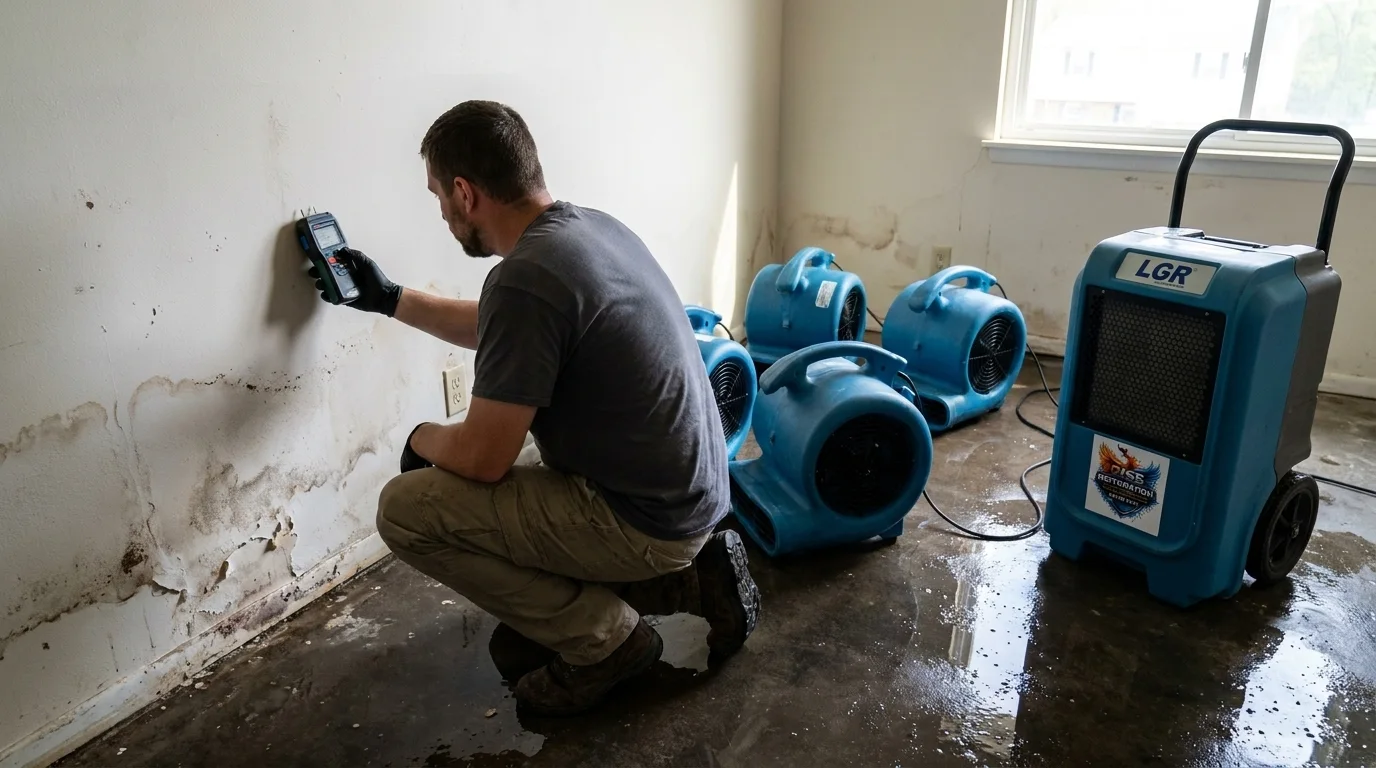
Inspection and moisture mapping. Thermal imaging and calibrated moisture meters locate water that has traveled beyond the visible wet area. In Struthers homes with plaster-over-lath walls, common in pre-1960 construction, the lath can stay saturated long after the plaster surface reads dry to the touch.
Water extraction. Truck-mounted and portable extraction units pull standing water from flooring, carpeting, and subfloor assemblies. The faster this step happens, the more material can be saved rather than replaced.
Structural drying. Industrial desiccant and refrigerant dehumidifiers, paired with high-velocity air movers, create a controlled drying environment. Drying logs are recorded daily so the insurance carrier has documentation of every reading.
Monitoring and clearance. Drying is not complete when the floor feels dry, it’s complete when moisture readings return to the regional equilibrium moisture content for this climate zone. We don’t pull equipment early.
Reaching Struthers from Youngstown
DISS Restoration is based in Youngstown, and Struthers is a direct run south on South Avenue or via Route 711, typically a short drive under normal conditions. Because the team is available around the clock, a call at 2 a.m. after a water heater fails gets the same response as a call at noon. We stage equipment locally so the truck that arrives is already loaded for extraction and drying, not making a second trip.
Insurance Coordination for Struthers Homeowners
Most homeowners’ policies in Ohio cover sudden and accidental water losses, a burst pipe, an appliance failure, an ice dam that forces water under the roof deck. What they typically exclude is long-term seepage, which is exactly the kind of loss that block basement walls in older Struthers homes can produce over time. Knowing that distinction matters before you file.
DISS documents every loss with photographs, moisture readings, and a written scope of work that aligns with the format insurance adjusters expect. We bill carriers directly and can communicate with your adjuster throughout the claim so you’re not translating between two technical vocabularies.
Local Note
In Struthers homes with original hardwood floors over unventilated crawl spaces, a construction pattern common in the neighborhoods that grew up near the former mill corridor, water extraction from the surface is only half the job. The crawl space beneath often retains humidity that wicks back up through the subfloor for days after the visible water is gone. Drying logs that don’t include crawl space readings will show a false clearance. We place sensors and dehumidification equipment below the floor as well as above it, because in this housing stock, that step is not optional.
If you’re dealing with water in your home right now, call DISS Restoration at (724) 981-1441. The crew is available 24/7, and the sooner extraction starts, the more of your structure and finishes can be saved.
Serving Struthers from our Youngstown headquarters — ★ 4.7 · 63 Google reviews
“This restoration company was able to take our weather related water intrusion job from start to finish within a very reasonable timeframe. The people we worked with communicated their next steps and asked questions when needed. The construction manager was always super quick to respond to my…” — Debbie, September 2026Read our reviews on Google →
Water Damage Restoration in Struthers: Service Coverage
Frequently Asked Questions
How fast can you arrive for water damage restoration in Struthers?
How quickly can DISS Restoration reach Struthers for a water emergency?
Are older Struthers homes with block basements harder to dry out after a water loss?
Does the clay soil common around Struthers affect how water enters a home during heavy rain?
What does the water damage restoration process actually look like inside a Struthers home?
Will my homeowner's insurance cover water damage to my Struthers home, and how does DISS handle the claim?
Water Damage Restoration response in Struthers
Most Struthers calls see a technician on-site within 60 minutes from our Youngstown headquarters.