24/7 Emergency Water Damage Restoration in Hubbard
24/7 emergency water damage restoration in Hubbard, OH. IICRC-certified, insurance billing accepted. Call (724) 981-1441.
Our IICRC-certified technicians are dispatched from our Youngstown, OH headquarters and are typically on-site in Hubbard within 60 minutes of your call.
Hubbard sits in the Mahoning Valley where freeze-thaw cycles hit hard every winter, and the region’s older housing stock, much of it built during the steel-boom decades of the mid-twentieth century, was never designed with today’s water intrusion risks in mind. When a pipe bursts behind a plaster wall or a sump pump fails during a spring thaw, water moves fast through these homes, and the window to prevent secondary damage like mold colonization is measured in hours, not days. DISS Restoration responds 24/7 from its Youngstown base and is on the ground in Hubbard when it counts.
Why Hubbard Properties See Water Damage Issues
The Mahoning Valley’s clay-heavy soils drain slowly. During heavy rain or rapid snowmelt, that saturation pushes hydrostatic pressure against basement walls and floor slabs in ways that catch homeowners off guard, especially in homes built before modern waterproofing standards were common. Hubbard’s residential neighborhoods contain a significant share of mid-century construction: block foundations, original cast-iron or galvanized plumbing, and crawl spaces that were never fully conditioned. Galvanized supply lines corrode from the inside out, often showing no visible warning before they fail. Cast-iron drain lines develop cracks and root intrusion that back up into lower-level living areas. Add the region’s pattern of hard winters followed by rapid spring warm-up, and the conditions for a water loss event are built into the landscape itself.
Flat or gently sloping lots common in this part of Trumbull County also mean surface water has fewer places to go. When downspouts discharge against a foundation rather than away from it, or when window wells fill faster than their drains can clear, basement water intrusion follows a predictable path, through mortar joints, around penetrations, and across the floor slab.
Our Water Damage Restoration Process in Hubbard
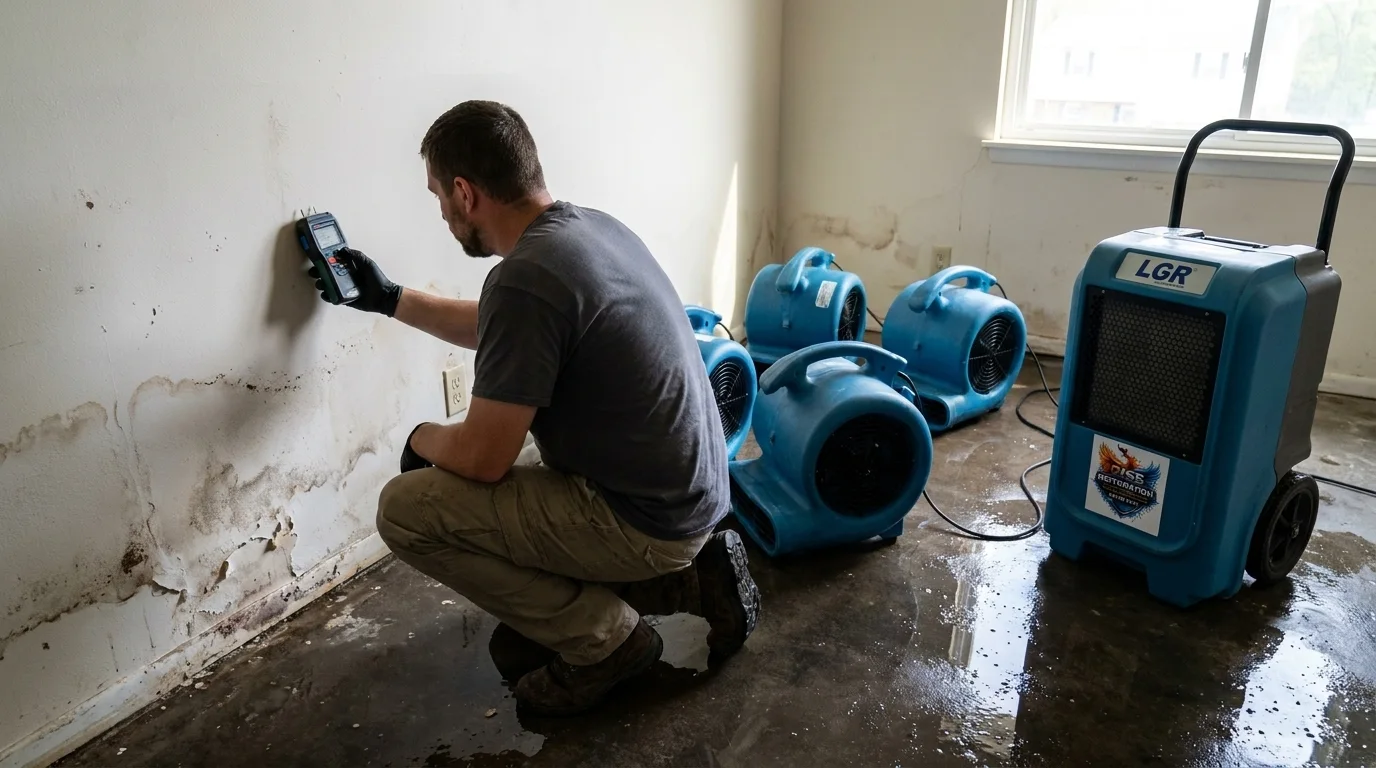
Every water loss starts with a thorough inspection before any equipment is placed. Using thermal imaging cameras and calibrated moisture meters, the crew maps where water has actually traveled, not just where it’s visible. In Hubbard’s older homes, that often means finding moisture behind plaster and lath, inside block wall cavities, and beneath original hardwood or vinyl tile floors where the subfloor has absorbed standing water.
Once the scope is documented, extraction comes first. Truck-mounted and portable extractors pull standing water from the structure before drying equipment is staged. Then industrial-grade desiccant and refrigerant dehumidifiers, paired with high-velocity air movers, are positioned to dry the structure from the inside out, a process governed by the IICRC S500 standard for water damage restoration. Moisture readings are logged at every visit so drying progress is documented and verifiable, which matters both for structural integrity and for insurance claim support.
When materials cannot be dried in place, saturated insulation, compromised drywall, or flooring with trapped moisture beneath it, controlled demolition removes only what is necessary. The goal is to dry the structure, not to over-demo it.
Reaching Hubbard from Youngstown
DISS Restoration operates out of Youngstown, and Hubbard is a short drive east along US-62. The route is direct and well-maintained year-round, which matters when a call comes in at 2 a.m. during a January ice event. Because the company operates around the clock, there is no waiting until morning for an assessment, a crew can be dispatched as soon as you call (724) 981-1441.
For properties on the eastern side of Hubbard closer to the Pennsylvania state line, access is equally straightforward. The team is familiar with the area’s road layout and does not need to navigate unfamiliar territory when every minute of response time has consequences for how far water has spread.
Local Note
One pattern worth knowing in Hubbard’s older neighborhoods: homes built with plaster-and-lath interior walls hold moisture differently than modern drywall construction. A moisture meter reading at the surface can show acceptable levels while the lath behind the plaster is still saturated, sometimes for weeks. Drying these assemblies correctly requires extended drying times and more frequent monitoring intervals than a comparable drywall home. Rushing the process or relying on surface readings alone leads to mold growth inside the wall cavity that isn’t visible until it’s already a larger problem. The IICRC ASD (Applied Structural Drying) certification the team holds is specifically relevant here, it covers the science of drying non-standard assemblies, not just open-stud drywall construction.
If you are dealing with water in a Hubbard home with original plaster walls, plan for a longer drying cycle and ask the technician to show you the moisture logs at each visit so you can see the trend line, not just the final reading.
Water damage does not pause while you weigh your options. If you are in Hubbard and water is in your home right now, call (724) 981-1441, DISS Restoration is available around the clock and can begin the assessment and extraction process before the situation escalates into a mold or structural issue.
Serving Hubbard from our Youngstown headquarters — ★ 4.7 · 63 Google reviews
“This restoration company was able to take our weather related water intrusion job from start to finish within a very reasonable timeframe. The people we worked with communicated their next steps and asked questions when needed. The construction manager was always super quick to respond to my…” — Debbie, September 2026Read our reviews on Google →
Water Damage Restoration in Hubbard: Service Coverage
Frequently Asked Questions
How fast can you arrive for water damage restoration in Hubbard?
How quickly can DISS Restoration reach Hubbard for a water emergency?
Hubbard has a lot of older homes with block foundations — does that change how water extraction works?
My Hubbard home has original plaster walls and the water got behind them. What should I expect from the drying process?
Will DISS Restoration work directly with my homeowner's insurance carrier for a water loss in Hubbard?
How do I know when structural drying is actually complete and it is safe to begin repairs in my Hubbard home?
Water Damage Restoration response in Hubbard
Most Hubbard calls see a technician on-site within 60 minutes from our Youngstown headquarters.