Asbestos Abatement in Youngstown
24/7 asbestos abatement in Youngstown and surrounding areas. IICRC-certified, insurance billing accepted. Call (724) 981-1441.
Asbestos becomes a problem the moment you disturb it. A drill bit through a 1960s floor tile, a contractor scraping a popcorn ceiling, a pipe insulation wrap that crumbles when touched, any of these can release microscopic fibers that stay airborne for hours and lodge permanently in lung tissue. The material itself is not the emergency; the disturbance is. That distinction shapes every decision in a proper asbestos abatement project, from how the work zone is sealed to how the waste leaves the property.
What asbestos abatement actually involves
Abatement is not simply pulling out suspect material and bagging it. It is a regulated sequence of containment, removal, air monitoring, and verified clearance, each step governed by EPA and OSHA standards that exist because airborne asbestos fibers are invisible and have no safe exposure threshold.
In Youngstown and the surrounding Mahoning Valley, the housing stock tells the story. A large share of the region’s homes were built between the 1940s and the late 1970s, when asbestos was a standard ingredient in floor tiles, ceiling texture, pipe wrap, duct insulation, roofing felt, joint compound, and exterior siding. Older two-story frames in neighborhoods like Brier Hill, Boardman, and Canfield often contain multiple asbestos-containing materials (ACMs) layered on top of each other, a vinyl tile installed over original asbestos tile, for example, or drywall compound applied over plaster that itself contains chrysotile fibers. Renovation projects that uncover these layers without prior testing are among the most common triggers for emergency abatement calls.
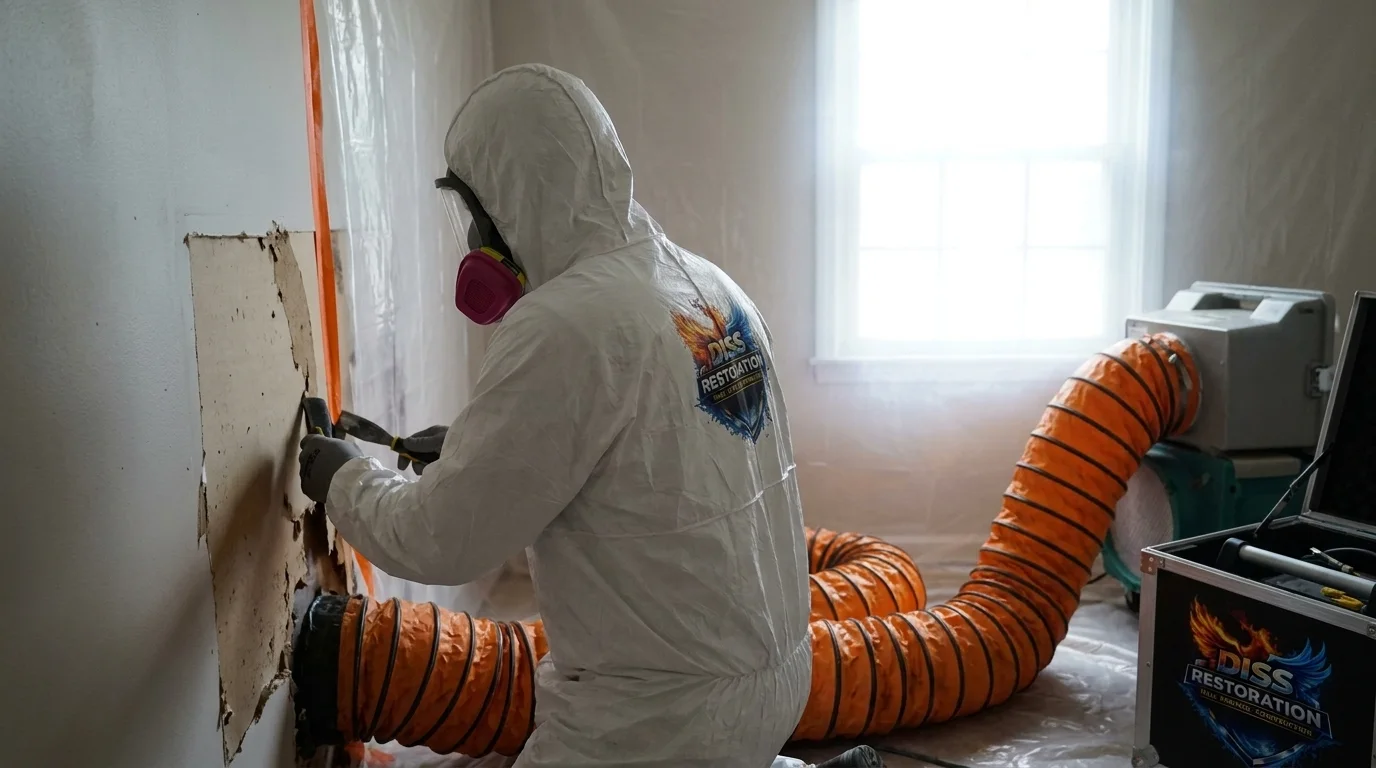
The work requires negative-air containment chambers, HEPA-filtered air scrubbers running continuously during removal, full-face respirators rated for asbestos (minimum P100 half-face or supplied-air for friable material), and wet-suppression methods to keep fibers from becoming airborne during extraction. Removed material is double-bagged in 6-mil poly, labeled per EPA regulations, and transported to a licensed disposal facility, it cannot go in a standard dumpster or curbside waste stream.
Timeline varies by scope. A single-room popcorn ceiling removal with proper containment typically runs one to two days. A whole-house abatement involving multiple ACM types, floor tile, pipe wrap, attic insulation, and roofing, can run a week or more, particularly when clearance air sampling must be completed before the containment is torn down.
Our process
-
Asbestos inspection and bulk sampling. Before any abatement plan is written, suspect materials are identified and sampled. Bulk samples are sent to an accredited laboratory for polarized light microscopy (PLM) analysis. Results typically return within 24–72 hours for standard turnaround, or same-day for rush analysis when a project cannot wait.
-
Abatement scope and regulatory notification. Once lab results confirm ACMs, a written scope of work is prepared. Depending on the quantity of material, state and local regulatory notification may be required before work begins, a step that less-experienced operators sometimes skip, creating liability for the property owner.
-
Containment and negative-air setup. The work area is isolated with 6-mil poly sheeting, critical barriers are taped at all penetrations, and HEPA air scrubbers are placed to maintain negative pressure inside the containment. Air flows in but cannot flow out without passing through the HEPA filter.
-
Wet removal and waste packaging. ACMs are wetted with amended water (a surfactant solution that reduces fiber release) before and during removal. Material is kept wet throughout handling, double-bagged, labeled, and staged in a decontamination unit before leaving the containment zone.
-
Clearance air sampling and containment teardown. After removal is complete and the area is HEPA-vacuumed and wet-wiped, air samples are collected inside the containment and analyzed. Only after clearance is confirmed does the poly come down. The clearance result, not the crew’s visual inspection, is the standard that matters.
What separates a good abatement response from a bad one
The most common failure in residential asbestos work is incomplete identification. A contractor scopes a popcorn ceiling removal, abates the ceiling, and leaves floor tile or joint compound untouched, materials that will be disturbed the moment the renovation resumes. A thorough asbestos inspection looks at all suspect materials in the work zone, not just the one the homeowner asked about.
The second common failure is inadequate containment. Negative pressure is not optional, it is what prevents fibers from migrating to adjacent rooms through HVAC returns, door gaps, and wall penetrations. A containment that is not verified with a smoke test or magnehelic gauge before work begins is a containment that may not be working.
Insurance adjusters and industrial hygienists look for three things in an abatement file: the original lab reports with chain-of-custody documentation, the regulatory notification paperwork (when applicable), and the post-abatement clearance air sample results. A project without all three is difficult to close, and may expose the property owner to liability if the work is later questioned.
EPA Lead-Safe certification is relevant here too: many Youngstown-area homes that contain asbestos also contain lead-based paint, and disturbing both in the same renovation requires coordinated handling protocols.
What does asbestos abatement cost?
Typical costs depend heavily on the type of material, whether it is friable (crumbles easily, releasing fibers) or non-friable, the square footage involved, and the accessibility of the work area. Most homeowners pay somewhere in the ranges below, these are industry-typical figures, not quotes.
| Scenario | Typical range |
|---|---|
| Asbestos inspection and bulk sampling (3–5 samples) | $300 – $700 |
| Popcorn ceiling removal, single room | $1,500 – $3,500 |
| Floor tile removal (per room) | $1,000 – $3,000 |
| Pipe insulation wrap (per linear foot) | $25 – $75 |
| Attic or crawl space insulation (vermiculite or loose-fill) | $5,000 – $15,000+ |
| Whole-house multi-material abatement | $10,000 – $30,000+ |
Every loss and every property is different, DISS Restoration provides a written scope of work before any abatement begins so there are no surprises mid-project. Homeowners insurance typically does not cover asbestos abatement that is discovered during a planned renovation, but it may cover abatement required as a direct result of a covered loss (such as a pipe burst that damages ACM-containing materials), your adjuster can confirm what your specific policy includes.
Seasonal and regional considerations
Youngstown’s freeze-thaw cycles drive a predictable surge in renovation activity each spring, when homeowners tackle projects deferred through winter. That seasonal push, combined with the age of the local housing stock, means asbestos discoveries during demo work are common between March and June. Scheduling an asbestos inspection before demolition begins, rather than after a contractor has already opened a wall, avoids the stop-work orders and emergency abatement costs that follow an uncontrolled release.
The region’s older industrial and commercial properties also carry a higher-than-average likelihood of asbestos-containing fireproofing on structural steel and mechanical insulation on large pipe systems, a consideration for any commercial renovation or building acquisition in Mahoning and Trumbull counties.
Service area
DISS Restoration serves Youngstown and the surrounding communities throughout the Mahoning Valley, including Boardman, Canfield, Austintown, Niles, Warren, Girard, Hubbard, and Sharon, PA. Each city service page links back here for the full technical detail on how asbestos abatement works, the local pages cover what is specific to each community’s housing stock and permitting contacts.
If you have found or suspect asbestos-containing material in your home or commercial property, the right first step is an inspection and bulk sample, not removal. Call (724) 981-1441 to schedule your asbestos inspection and get a written scope before any work begins.
Services We Handle
- Asbestos & Lead Abatement
- Lead Abatement
Frequently Asked Questions
Does homeowners insurance cover asbestos abatement?
What is the difference between friable and non-friable asbestos, and does it change how the work is done?
Can I test for asbestos myself with a home kit before calling a professional?
What does post-abatement clearance air sampling actually test for, and who reviews the results?
My contractor already disturbed what might be asbestos during a renovation. What should happen next?
Looking for the best asbestos abatement company in Youngstown?
DISS Restoration provides asbestos abatement in Youngstown, OH and the surrounding area, and has served local property owners since 2021. Customers rate us 4.7 out of 5 stars across 63 Google reviews. We answer calls 24/7 — call (724) 981-1441 for immediate help.
Need Asbestos Abatement now?
We respond 24/7 across Youngstown and surrounding OH cities.