24/7 Emergency Basement Flooding Cleanup in Youngstown
24/7 emergency basement flooding cleanup in Youngstown and surrounding areas. IICRC-certified, insurance billing accepted. Call (724) 981-1441.
Water pooling in your basement right now? DISS Restoration answers 24/7 for basement flooding anywhere in the Youngstown area, and getting water out fast matters more here than almost anywhere else in the house, because basements sit below grade where humidity is already higher and drying takes longer.
A flooded basement rarely announces itself the way a burst pipe upstairs does. It’s a sump pump that quietly failed overnight, a foundation crack that seeps during a heavy rain, or a floor drain backing up after the ground freezes and thaws. By the time you notice the smell or see water creeping across the slab, carpet pad, drywall, and stored boxes have often been sitting in it for hours. Mold can begin colonizing organic material within 24 to 48 hours of a flood, which is why the window between discovery and extraction matters as much as the extraction itself.
What basement flooding cleanup actually involves
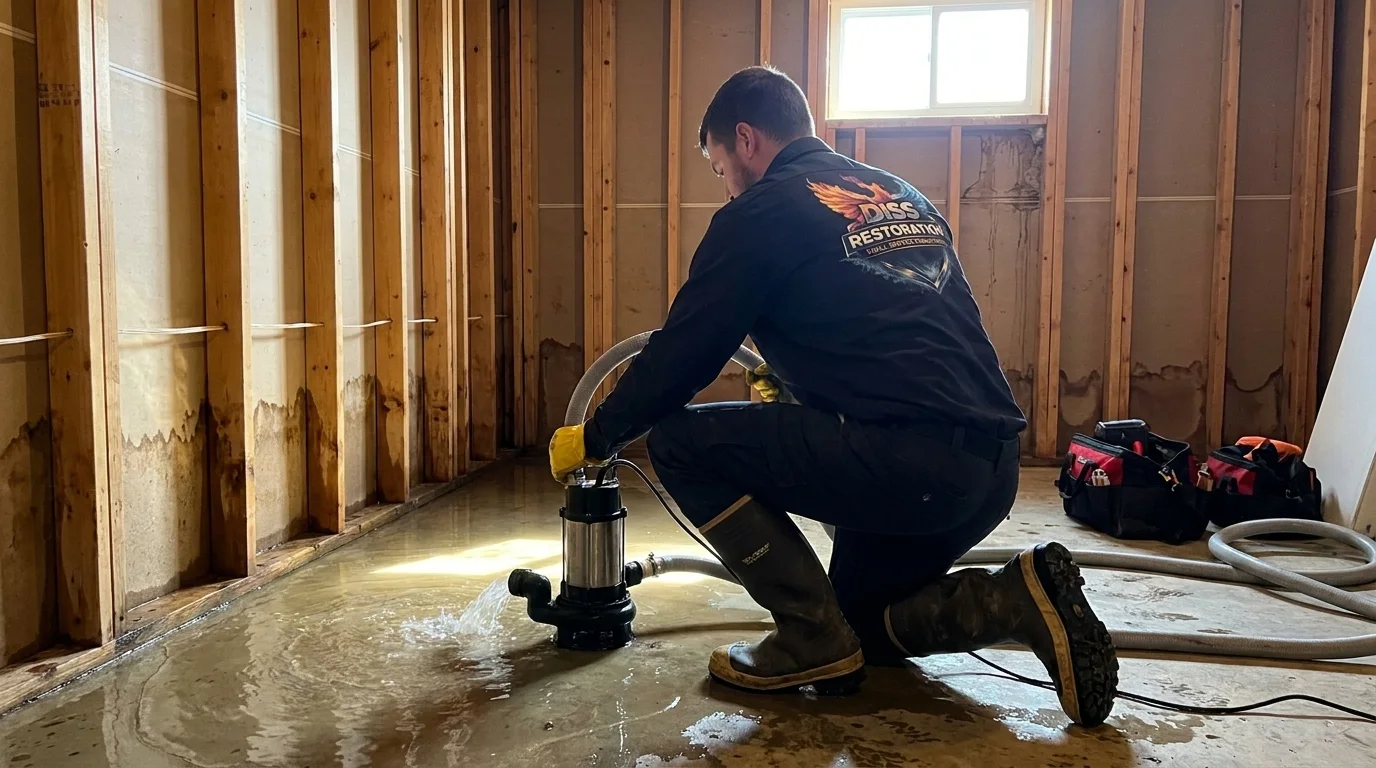
Basement water removal is its own discipline because the environment works against you. Concrete and masonry hold moisture longer than wood framing, below-grade humidity is naturally higher, and there’s often less air exchange than in above-grade rooms. Crews pump or extract standing water first, then pull saturated carpet, pad, and any drywall that’s wicked water above the flood line, typically the bottom 12 to 24 inches depending on how long it sat. Air movers and commercial dehumidifiers run next, sized to the square footage and the concrete’s moisture load, not just the air in the room. A basement with finished walls, stored belongings, or a furnace and water heater down there takes longer to dry and assess than an unfinished utility space.
Our process
- Source and category identification. We confirm whether the water is clean (sump failure, supply line), gray (washing machine overflow), or black water from a sewage backup, since that classification changes the entire scope and what materials can be saved.
- Extraction. Standing water comes out with submersible pumps and truck-mount or portable extraction units, prioritizing speed to limit how far moisture migrates into framing and subfloor.
- Removal of unsalvageable materials. Saturated carpet pad, baseboards, and drywall that tested wet are removed to expose the wall cavity and slab for drying, rather than drying over materials that will trap moisture and feed mold later.
- Structural drying and moisture monitoring. Air movers and dehumidifiers are placed per IICRC S500 drying principles, with moisture readings logged daily in the concrete, framing, and any remaining drywall until they return to a dry standard.
- Post-drying inspection. Before closing out the job, we verify moisture content across the slab and wall cavities, not just surface-dry to the touch, since concrete can feel dry while still holding moisture deeper in the pour.
What separates a good basement flooding response from a bad one
The most common mistake is drying the air in the room without addressing the slab and wall cavities underneath it. A basement can feel dry within a day while the concrete itself stays saturated for a week or more, and closing up drywall or flooring over that moisture is how mold shows up a month later. Another frequent miss is treating all basement water the same regardless of source. A sump pump failure with clean groundwater behaves very differently than a sewer backup, which carries contamination and requires different materials handling and disposal. Insurance adjusters generally want documented moisture readings over time, not just a single before-and-after photo, along with a clear explanation of why specific materials were removed rather than dried in place. Operators who skip that documentation often leave homeowners arguing with a carrier later over what was actually necessary.
What does basement flooding cleanup cost?
Costs vary with how much water was involved, how long it sat before cleanup started, the water category, and whether the basement is finished or unfinished. Every loss is different, which is why DISS Restoration provides a written scope of work before any cleanup begins. Homeowners insurance typically covers sudden and accidental water losses, such as a sump pump or appliance failure, but often excludes gradual seepage or groundwater flooding without a separate rider.
| Scenario | Typical range |
|---|---|
| Sump pump failure, small basement, clean water | $1,200 - $3,000 |
| Moderate flooding with saturated carpet and pad | $2,500 - $6,000 |
| Foundation seepage with drywall and framing at risk | $3,500 - $8,000 |
| Sewage backup, Category 3 contamination | $5,000 - $12,000+ |
| Finished basement requiring drywall and flooring replacement | $6,000 - $15,000+ |
Seasonal & regional considerations
The Mahoning Valley’s freeze-thaw cycle is hard on older foundations. Many homes around Youngstown were built with fieldstone, block, or aging poured concrete that develops hairline cracks over decades, and those cracks let groundwater in during spring thaw and heavy spring rains. Power outages during winter storms are also a common trigger for basement flooding, since a sump pump that loses power during a storm can’t keep up with snowmelt or runoff. Basements with older galvanized or cast iron drain lines are also more prone to backups during heavy rain events when municipal systems are under load.
Service area
DISS Restoration handles basement flooding cleanup throughout Youngstown and the surrounding Mahoning Valley communities, including the older housing stock and below-grade foundations common across the region.
If water is sitting in your basement right now, stop walking through it and call (724) 981-1441 to schedule extraction and get a written drying plan started before the slab and framing hold onto moisture any longer.
Frequently Asked Questions
Does homeowners insurance cover basement flooding cleanup?
How fast does mold start growing after a basement floods?
What's the difference between a sump pump failure and a sewage backup for cleanup purposes?
Why does a basement take longer to dry out than a flooded room upstairs?
Can we keep using the rest of the house while our basement is being dried out?
Looking for the best basement-flooding-cleanup company in Youngstown?
DISS Restoration provides basement-flooding-cleanup in Youngstown, OH and the surrounding area, and has served local property owners since 2021. Customers rate us 4.7 out of 5 stars across 63 Google reviews. We answer calls 24/7 — call (724) 981-1441 for immediate help.
Need basement-flooding-cleanup now?
We respond 24/7 across Youngstown and surrounding OH cities.
Related Coverage
- Our Restoration Services
- Contact DISS Restoration
- Restoration Services in Austintown
- Restoration Services in Boardman
- Restoration Services in Campbell
- Restoration Services in Canfield
- Restoration Services in Farrell
- Restoration Services in Girard
- Restoration Services in Greenville
- Restoration Services in Grove City
- Restoration Services in Hermitage
- Restoration Services in Hubbard
- Restoration Services in Mercer
- Restoration Services in Mineral Ridge