24/7 Emergency Ceiling Water Damage Repair in Youngstown
24/7 emergency ceiling water damage repair in Youngstown and surrounding areas. IICRC-certified, insurance billing accepted. Call (724) 981-1441.
Water coming through your ceiling or a brown stain spreading overhead? That’s not cosmetic. It means water is actively tracking through your roof deck, attic insulation, or the floor above, and it’s sitting in the drywall and framing right now. We answer 24/7, and the longer a saturated ceiling sits, the more likely you’re looking at a sagging ceiling, a collapse risk, or mold colonizing inside the cavity within 24 to 48 hours.
What ceiling water damage repair actually involves
A leaking ceiling is rarely just a ceiling problem. Water that stains drywall has usually already passed through roofing material, attic framing, insulation, or a second-floor subfloor before it showed up as a brown ring or a wet spot overhead. Repair work starts with finding where the water is actually entering, not just where it’s visible, because a stain six feet from the real leak point is common once water follows a joist or truss before dripping down. Depending on what we find, the job can involve cutting out saturated drywall, removing wet insulation, drying exposed framing with air movers and dehumidifiers, and then rebuilding the ceiling assembly once moisture readings confirm the structure is dry. A small isolated stain might be a one-day job. A sagging ceiling with saturated insulation above it is a multi-day drying and reconstruction project.
Our process
- Source identification - we trace the leak path (roof penetration, plumbing line, HVAC condensate, or a tub/shower above) before touching the ceiling, because repairing drywall without stopping the source just means doing it again.
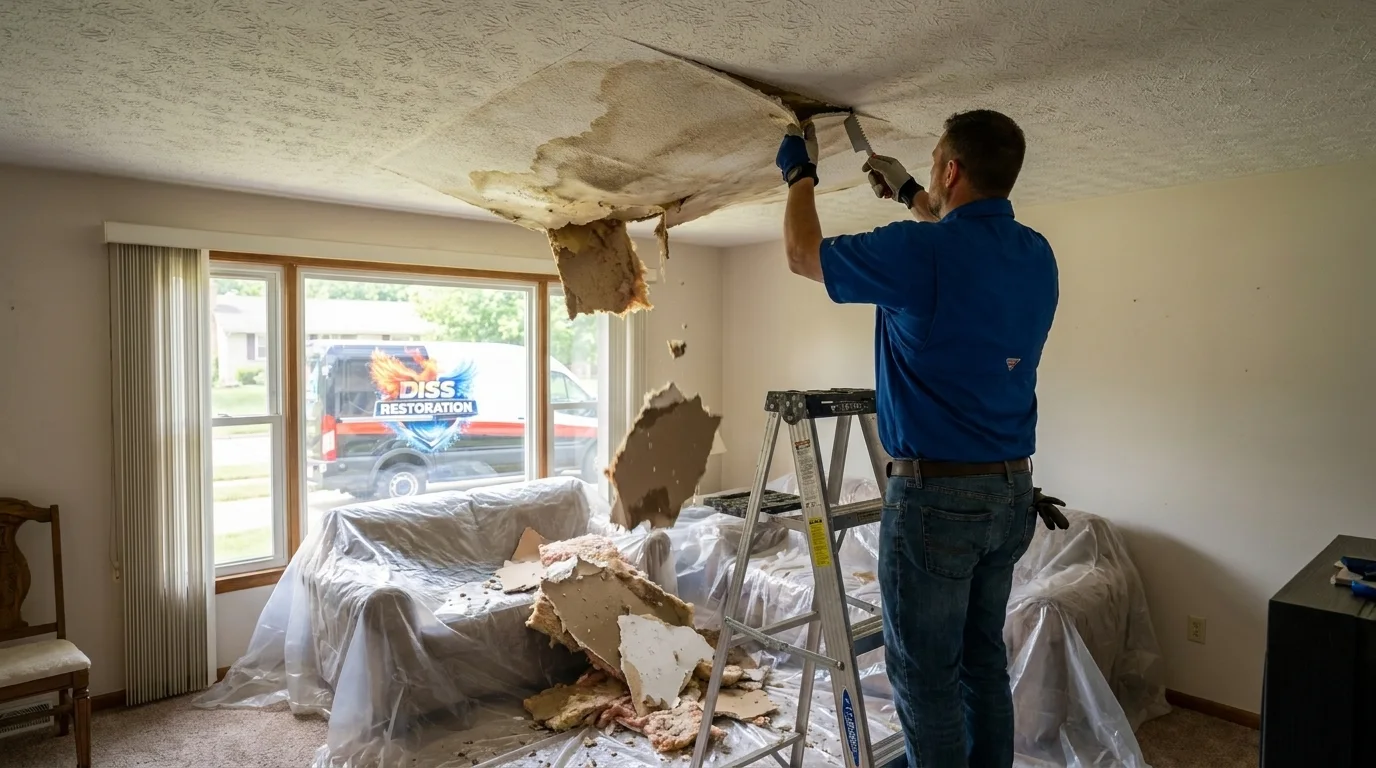
- Containment and controlled demolition - if the ceiling is sagging or the drywall has lost structural integrity, we open it in a controlled way to relieve water weight and expose wet framing and insulation, rather than letting it fail on its own.
- Drying the cavity, not just the surface - moisture meters and often a thermal camera check the joists, subfloor above, and insulation, since a ceiling can look dry on the painted side while the framing above stays wet for days.
- Monitoring until structural materials read dry - we track moisture content daily against dry standards before any rebuild starts, consistent with IICRC S500 drying guidelines.
- Rebuild - new drywall, taping, texture match, and paint, scoped to match the existing ceiling finish where possible.
What separates a good ceiling water damage response from a bad one
The most common mistake is patching the visible stain and skipping the cavity above it. Paint-and-patch jobs that don’t address wet insulation or framing almost always come back as a mold problem or a second stain within a season, because fiberglass and cellulose insulation hold moisture long after the drywall face reads dry to the touch. Another miss is ignoring the electrical: ceiling fixtures, can lights, and wiring runs sit inside that same cavity, and water-damaged junction boxes are a fire and shock hazard that a quick drywall patch does nothing to address. Insurance adjusters evaluating these claims are specifically looking for documented moisture readings before and after drying, photos of the source point (not just the stain), and whether insulation was replaced or just dried in place, since soaked insulation loses R-value even after it technically dries.
What does ceiling water damage repair cost?
Costs vary widely based on how much of the ceiling and framing is affected, whether insulation has to be replaced, and whether the source has already been fixed or still needs a roofer or plumber. Every loss is different, which is why we provide a written scope before any work begins. Homeowners insurance typically covers the cost of repair when the water source is sudden and accidental, such as a burst pipe or a storm-damaged roof, but it generally excludes damage from a long-term, known leak that went unrepaired.
| Scenario | Typical range |
|---|---|
| Small stain, surface only, no insulation loss | $350 - $900 |
| Localized drywall cutout, dry-in-place framing | $800 - $2,200 |
| Sagging ceiling, insulation replacement, partial rebuild | $2,000 - $5,500 |
| Large ceiling section with framing repair | $4,500 - $10,000+ |
| Combined with roof or plumbing source repair | Add $500 - $3,000+ depending on trade |
Seasonal & regional considerations
Youngstown winters bring ice damming on older roof lines, where melting snow refreezes at the eaves and backs water up under shingles, often showing up as a ceiling leak along an exterior wall weeks after the original snowfall. The area’s housing stock, with a large share of homes built mid-century, often has older cast iron or galvanized plumbing stacks running through second-floor ceilings, which fail from the inside and leak into the ceiling cavity below before any wall staining appears. Spring thaw and summer storm season bring a second wave of roof-related ceiling leaks as freeze-thaw cycles work loose flashing and shingle seals.
Service area
We handle ceiling water damage repair throughout Youngstown and the surrounding Mahoning Valley communities, including the older housing stock common across the region’s established neighborhoods.
If water is actively dripping or a ceiling section feels soft or is sagging, stop using the room below it and call (724) 981-1441 to schedule your moisture assessment before the damage spreads further into the framing.
Services We Handle
- Roof Leak Water Damage
Frequently Asked Questions
Does homeowners insurance cover ceiling water damage repair?
Why is my ceiling sagging instead of just stained?
Can you fix a water-stained ceiling without replacing the whole thing?
How do you find where water is entering if the stain is in the middle of the ceiling?
Is it safe to leave ceiling light fixtures on if there's a stain near them?
Looking for the best ceiling-water-damage-repair company in Youngstown?
DISS Restoration provides ceiling-water-damage-repair in Youngstown, OH and the surrounding area, and has served local property owners since 2021. Customers rate us 4.7 out of 5 stars across 63 Google reviews. We answer calls 24/7 — call (724) 981-1441 for immediate help.
Need ceiling-water-damage-repair now?
We respond 24/7 across Youngstown and surrounding OH cities.
Related Coverage
- Our Restoration Services
- Contact DISS Restoration
- Restoration Services in Austintown
- Restoration Services in Boardman
- Restoration Services in Campbell
- Restoration Services in Canfield
- Restoration Services in Farrell
- Restoration Services in Girard
- Restoration Services in Greenville
- Restoration Services in Grove City
- Restoration Services in Hermitage
- Restoration Services in Hubbard
- Restoration Services in Mercer
- Restoration Services in Mineral Ridge