24/7 Emergency Board-Up and Tarping in Youngstown
24/7 emergency board-up and tarping in Youngstown and surrounding areas. IICRC-certified, insurance billing accepted. Call (724) 981-1441.
A broken window, a fire-scorched wall, or a roof torn open by a storm doesn’t pause while you figure out next steps. Within hours, rain soaks into exposed framing, opportunistic theft becomes a real risk, and your insurance adjuster is already asking whether the property was secured. Emergency board-up and tarping is the work that happens in that gap, before restoration can begin, and how well it’s done determines how much additional damage your property sustains in the meantime.
What emergency board-up and tarping actually involves
Board-up and tarping is structural security and weather protection applied to a property that has been suddenly compromised. It is not a permanent repair. The goal is to stop the clock on secondary damage, wind-driven rain into an open roof, vandalism through a broken storefront window, or accelerated fire damage from moisture entering a smoke-weakened structure.
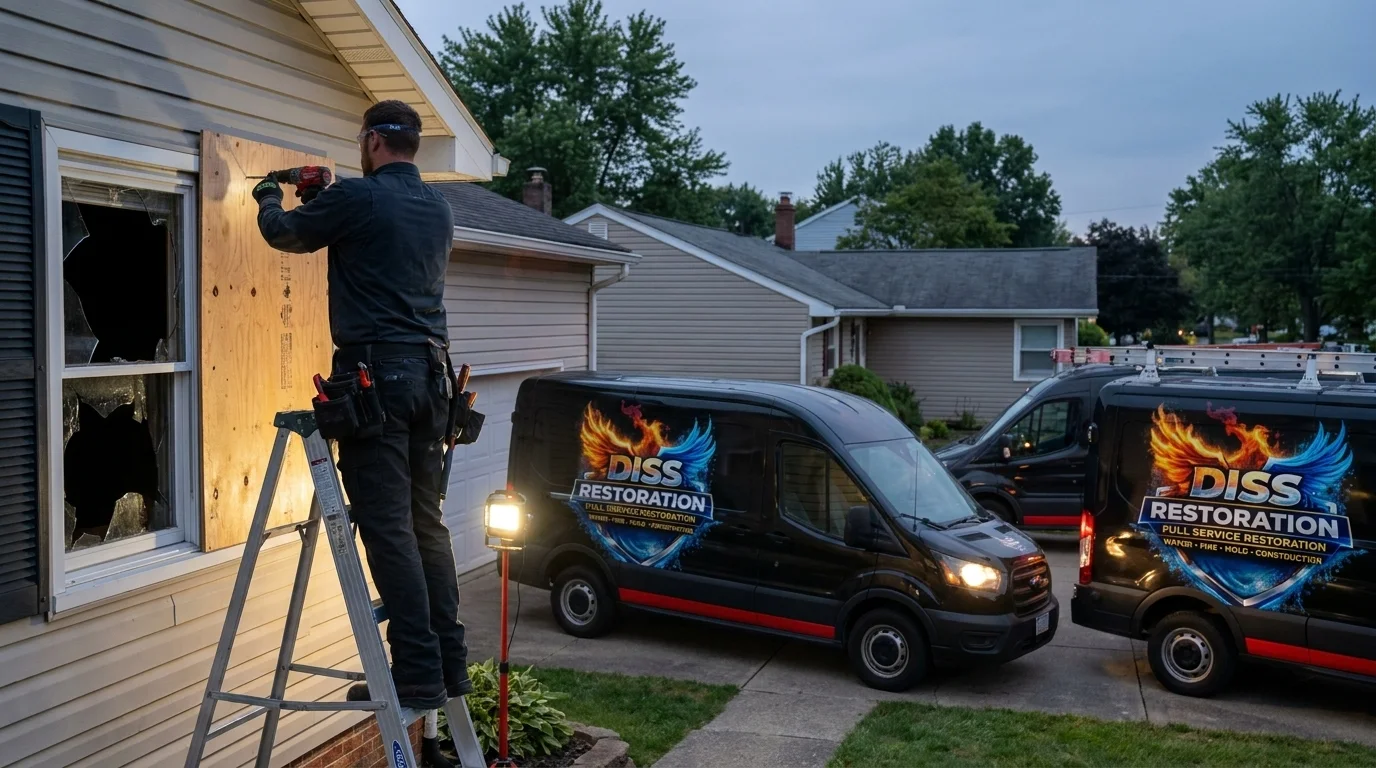
On the board-up side, that means cutting and fastening plywood panels, typically 3/4-inch CDX, over window openings, door frames, and breached walls. Panels are secured with structural screws or through-bolts depending on the substrate, not staples or tape. For fire-damaged structures, crews assess whether the framing around the opening can hold a load before fastening into it.
Roof tarping involves laying heavy-duty polyethylene tarps, 6-mil minimum, often thicker for extended exposure, over damaged sections and anchoring them with wood battens screwed into undamaged decking on either side of the breach. A tarp that is simply draped and weighted is not a secured tarp; it will lift in 30-mph wind and leave the opening exposed.
The work typically takes two to four hours for a single-family home with moderate damage. Larger commercial losses or multi-breach events take longer. DISS Restoration responds around the clock, because a breach at 2 a.m. is not a problem that waits until morning.
Our process
-
Site assessment and hazard check. Before any material goes up, the crew walks the perimeter and identifies structural hazards, weakened roof sections, compromised load-bearing walls, active utilities near the breach. On fire-damaged properties, this step also flags areas where thermal damage may make fastening unsafe.
-
Documentation for your insurance claim. Every opening is photographed before it is covered. Measurements are recorded. The cause and extent of the breach is noted in writing. This documentation becomes part of the claim file and protects you if a carrier questions the scope of emergency services later.
-
Board-up installation. Plywood panels are cut to fit each opening, fastened into structurally sound framing, and sealed at the edges where weather infiltration is likely. On multi-story properties, lifts or ladders are staged safely before work begins.
-
Roof tarping and anchor installation. Tarps are positioned to overlap the damaged area by at least two feet on each side, then secured with 2x4 battens screwed into solid decking. Ridge caps and valleys are addressed separately to prevent water channeling under the tarp edge.
-
Final walkthrough and written scope. Before leaving, the crew confirms every breach is covered, photographs the completed work, and provides a written scope of what was installed. That document goes to you and, when applicable, directly to your insurance carrier.
What separates a good board-up response from a bad one
The most common failure in emergency board-up is speed prioritized over method. A crew that staples 1/2-inch OSB over a window opening and leaves has technically “boarded up” the property, but that panel will flex in wind, allow water infiltration at the seams, and may not satisfy your carrier’s requirement for adequate securing.
Insurance adjusters look for documentation first. A board-up that was never photographed before installation is difficult to include in a claim. Adjusters also look at whether the securing method was appropriate for the breach type, a tarp held down by bricks on a flat roof is not the same as a battened tarp on a pitched surface, and carriers know the difference.
On fire-damaged properties specifically, the interaction between board-up and smoke odor matters. Sealing a structure too tightly without ventilation planning can concentrate soot particulates and accelerate odor penetration into porous materials. DISS Restoration’s IICRC FSRT certification means crews understand how fire and smoke behave inside a structure, not just how to cover the hole.
For properties with lead paint, common in Youngstown’s pre-1978 housing stock, any cutting or fastening into painted surfaces triggers EPA Lead-Safe work practice requirements. DISS Restoration is EPA Lead-Safe Certified, which matters both for occupant safety and for regulatory compliance during the claim process.
What does emergency board-up and tarping cost?
Typical costs vary based on the number of openings, the size of the breach, roof pitch and accessibility, and whether the structure has hazards that require additional staging. Most homeowners pay somewhere in the ranges below, these are industry-typical figures, not quotes.
| Scenario | Typical range |
|---|---|
| Single broken window, residential | $150 – $400 |
| Multiple windows and one door, residential | $500 – $1,200 |
| Small roof breach (storm or fallen limb) | $400 – $900 |
| Large roof section, steep pitch or multi-story | $900 – $2,500 |
| Fire-damaged structure, full perimeter board-up | $1,500 – $4,000 |
| Commercial storefront, multi-opening | $800 – $3,000 |
Every loss is different, and DISS Restoration provides a written scope before work begins so there are no surprises. Homeowners insurance typically covers emergency board-up and tarping as part of the covered loss, it falls under the duty-to-mitigate provision that requires policyholders to prevent further damage after a covered event.
Seasonal and regional considerations
Northeast Ohio’s winters make a slow board-up response measurably more expensive. A roof breach that sits open overnight in January allows snow infiltration, ice damming at the tarp edge, and freeze-thaw cycling in exposed framing, damage that compounds daily. Youngstown averages significant lake-effect snowfall, and storms that open roofs often arrive with sustained wind that continues after the initial damage. Tarps installed without proper battening will not survive that wind load.
Summer storm season brings its own pattern: fast-moving cells that drop large limbs on roofs, often in the evening hours when contractor availability drops. The combination of saturated wood, warm temperatures, and a multi-day wait for tarping creates ideal conditions for mold colonization to begin within 24 to 48 hours of the breach.
Service area
DISS Restoration is based in Youngstown and provides emergency board-up and tarping throughout the surrounding region, including Boardman, Austintown, Canfield, Niles, Warren, Hubbard, and Struthers, as well as communities across Mahoning and Trumbull counties. Individual city-specific pages are linked from the service area section of this site.
If your property has been breached and you are not sure whether you are in the service area, call, the answer is almost always yes.
If your home or building has an opening that shouldn’t be there, call DISS Restoration at (724) 981-1441 to get it secured before the weather or the night makes it worse.
Services We Handle
- Board Up Residential
- Boarding Up and Tarping
- Emergency Tarping
Frequently Asked Questions
Does homeowners insurance cover emergency board-up and tarping?
What thickness of plywood is required for a board-up to satisfy an insurance adjuster?
How long can a roof tarp realistically stay in place before it needs to be replaced or a permanent repair is made?
My house had a fire. Does the board-up process differ from a storm or break-in board-up?
What should I do — and not do — at the property while waiting for the board-up crew to arrive?
Looking for the best emergency board-up and tarping company in Youngstown?
DISS Restoration provides emergency board-up and tarping in Youngstown, OH and the surrounding area, and has served local property owners since 2021. Customers rate us 4.7 out of 5 stars across 63 Google reviews. We answer calls 24/7 — call (724) 981-1441 for immediate help.
Need Emergency Board-Up and Tarping now?
We respond 24/7 across Youngstown and surrounding OH cities.
Related Coverage
- Our Restoration Services
- Contact DISS Restoration
- 24/7 Emergency Board-Up and Tarping in Austintown
- 24/7 Emergency Board-Up and Tarping in Boardman
- 24/7 Emergency Board-Up and Tarping in Canfield
- 24/7 Emergency Board-Up and Tarping in Girard
- 24/7 Emergency Board-Up and Tarping in Hubbard
- 24/7 Emergency Board-Up and Tarping in Niles
- 24/7 Emergency Board-Up and Tarping in Struthers
- 24/7 Emergency Board-Up and Tarping in Warren