
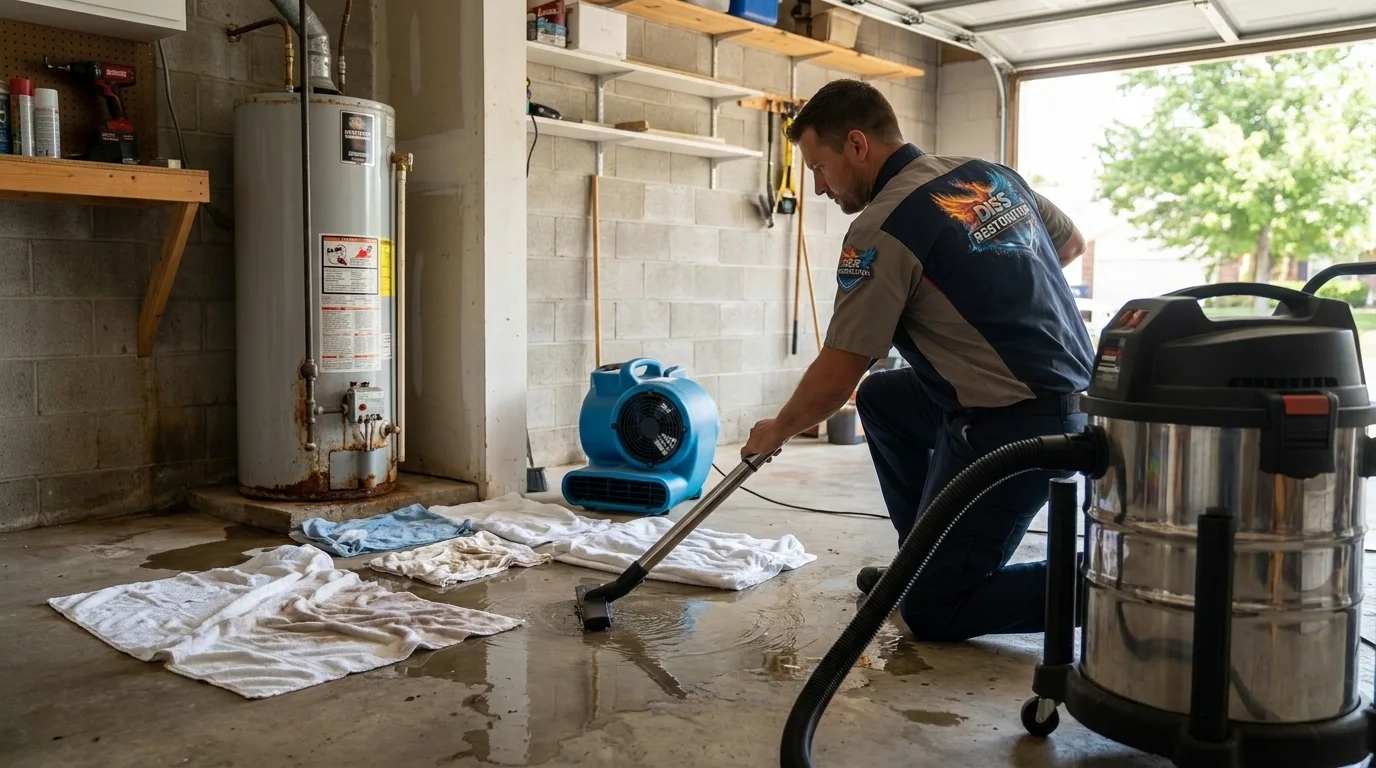
24/7 Emergency Water Heater Flood Cleanup in Youngstown
24/7 emergency water heater flood cleanup in Youngstown and surrounding areas. IICRC-certified, insurance billing accepted. Call (724) 981-1441.
Water heater flood cleanup in Youngstown? We answer 24/7. A leaking or burst water heater rarely announces itself with a dramatic flood. More often it’s a slow drip behind the tank that soaks into subfloor for days before anyone notices the carpet feels spongy near the laundry room, or it’s a full tank failure that dumps 40-80 gallons across a finished basement in minutes. Either way, the clock on drywall saturation and microbial growth starts the moment water hits the floor, not when you call.
What water heater flood cleanup actually involves
A failed water heater creates two separate problems: the water itself, and what the water picks up on its way out. Tanks that fail from internal corrosion or sediment buildup release water carrying rust, mineral scale, and sometimes bacterial growth from standing sediment, which is treated as Category 2 water rather than the clean Category 1 water from a fresh supply line fitting failure. That distinction changes how aggressively we handle flooring, baseboards, and wall cavities.
Most residential water heaters sit in a basement, a utility closet, or a garage, which means the water has somewhere to travel before it’s visible: under laminate flooring, into the wall cavity behind the unit, beneath carpet pad in an adjacent room, or down into a finished ceiling if the heater is on an upper floor. The visible puddle is usually the smallest part of the loss. Equipment on a job like this typically includes submersible pumps or wet vacs for extraction, moisture meters to map how far water traveled through porous materials, and air movers and dehumidifiers sized to the affected space, run and monitored until materials read dry, not just until they look dry.
Our process
- Shut down the source. Before anything else, the water supply line to the tank is shut off, and if the tank is gas-fired or electric, that utility is isolated so cleanup can happen safely.
- Extract standing water. Pumps and extraction tools remove bulk water from flooring, carpet, and any low points before it has more time to wick into subfloor or baseboards.
- Categorize and inspect. The water is assessed for contamination level based on tank condition and how long it sat, which determines whether flooring and wall base can be dried in place or need to come out.
- Map moisture and dry. Moisture meters document how far the water traveled, including into the wall behind the tank and under adjacent flooring, and drying equipment is placed and monitored against that map, not removed on a guess.
- Verify and document. Final moisture readings confirm materials are back to dry standard, with documentation for your insurance file showing the loss, the equipment used, and the drying timeline.
What separates a good water heater flood response from a bad one
The most common mistake is drying only the visible wet area and missing water that traveled under flooring or into the wall cavity directly behind or beside the tank, which is often enclosed and poorly ventilated. In a closet installation, that trapped moisture can support mold growth within 24 to 48 hours even while the surrounding room looks dry. A second mistake is treating all water heater leaks as clean water when a tank that failed from internal corrosion or had standing sediment for years is carrying contamination that should change the approach to porous materials like carpet pad and particle-board subfloor.
Insurance adjusters reviewing a water heater claim generally want to see documented moisture readings from before and after drying, photos of the tank and the extent of water travel, and a clear explanation of why any materials were removed rather than dried in place. A written scope that ties the demolition decisions to actual moisture data holds up better than one based on visual judgment alone.
What does water heater flood cleanup cost?
Costs depend heavily on how long the leak went undetected, how far water traveled, and what materials were affected. A slow leak caught within a closet costs far less to remediate than a tank that failed overnight and spread into a finished basement or a room below. Every loss is different, and DISS Restoration provides a written scope of work before any cleanup begins so you know what’s included and why.
| Scenario | Typical range |
|---|---|
| Water heater closet only, caught quickly | $500 - $1,500 |
| Leak into basement, hard-surface flooring | $1,200 - $3,000 |
| Spread into carpeted room, drywall affected | $2,500 - $6,000 |
| Multi-level leak damaging ceiling below | $4,000 - $10,000 |
| Tank failure with sediment contamination, flooring removal needed | $3,500 - $8,000 |
Homeowners insurance typically covers sudden and accidental water heater failures, including the resulting cleanup and drying, though coverage for replacing the tank itself can depend on your policy and the tank’s age.
Seasonal & regional considerations
Youngstown’s housing stock includes a large share of homes built from the 1920s through the 1970s, many with water heaters tucked into basements alongside original or older plumbing. Tank water heaters generally last 8 to 12 years, and failures tend to cluster during colder months when incoming water temperature is lowest and the tank works hardest, putting extra strain on aging tanks and fittings right as winter sets in.
Service area
DISS Restoration handles water heater flood cleanup throughout Youngstown and surrounding communities including Boardman, Austintown, Warren, and Niles.
If your water heater has leaked or failed, shut off the water and call (724) 981-1441 to schedule your water heater flood cleanup before moisture spreads further into flooring and walls.
Frequently Asked Questions
Does homeowners insurance cover water heater flood damage?
How do I know if my water heater leak is Category 1 or Category 2 water?
What happens if a water heater leak goes unnoticed for several days?
Can flooring be saved after a water heater floods, or does it have to be replaced?
How long does drying take after a water heater floods a basement or closet?
Looking for the best water-heater-flood-cleanup company in Youngstown?
DISS Restoration provides water-heater-flood-cleanup in Youngstown, OH and the surrounding area, and has served local property owners since 2021. Customers rate us 4.7 out of 5 stars across 63 Google reviews. We answer calls 24/7 — call (724) 981-1441 for immediate help.
Need water-heater-flood-cleanup now?
We respond 24/7 across Youngstown and surrounding OH cities.
Related Coverage
- Our Restoration Services
- Contact DISS Restoration
- Restoration Services in Austintown
- Restoration Services in Boardman
- Restoration Services in Campbell
- Restoration Services in Canfield
- Restoration Services in Farrell
- Restoration Services in Girard
- Restoration Services in Greenville
- Restoration Services in Grove City
- Restoration Services in Hermitage
- Restoration Services in Hubbard
- Restoration Services in Mercer
- Restoration Services in Mineral Ridge