TL;DR: After a house fire in Youngstown, call your insurance company to open a claim, then call an IICRC-certified fire damage restoration company to secure the property and begin mitigation. Soot and smoke damage spread fast, every hour without containment increases the total loss. A certified crew handles emergency board-up, smoke and odor removal, structural drying, and full rebuild coordination, and documents everything your adjuster needs.
If the fire marshal just cleared you to re-enter your Youngstown home and you’re standing in the doorway looking at charred walls and soot-coated ceilings, the next 24 hours matter more than most people realize. Smoke residue is acidic. It keeps etching metal fixtures, discoloring grout, and embedding into porous surfaces long after the flames are out. The faster a certified crew gets in to contain the damage and start controlled demolition, the more of your home, and your claim, is preserved. Full service details are on the Youngstown fire damage restoration page.
What Does Fire Damage Restoration Actually Cover?
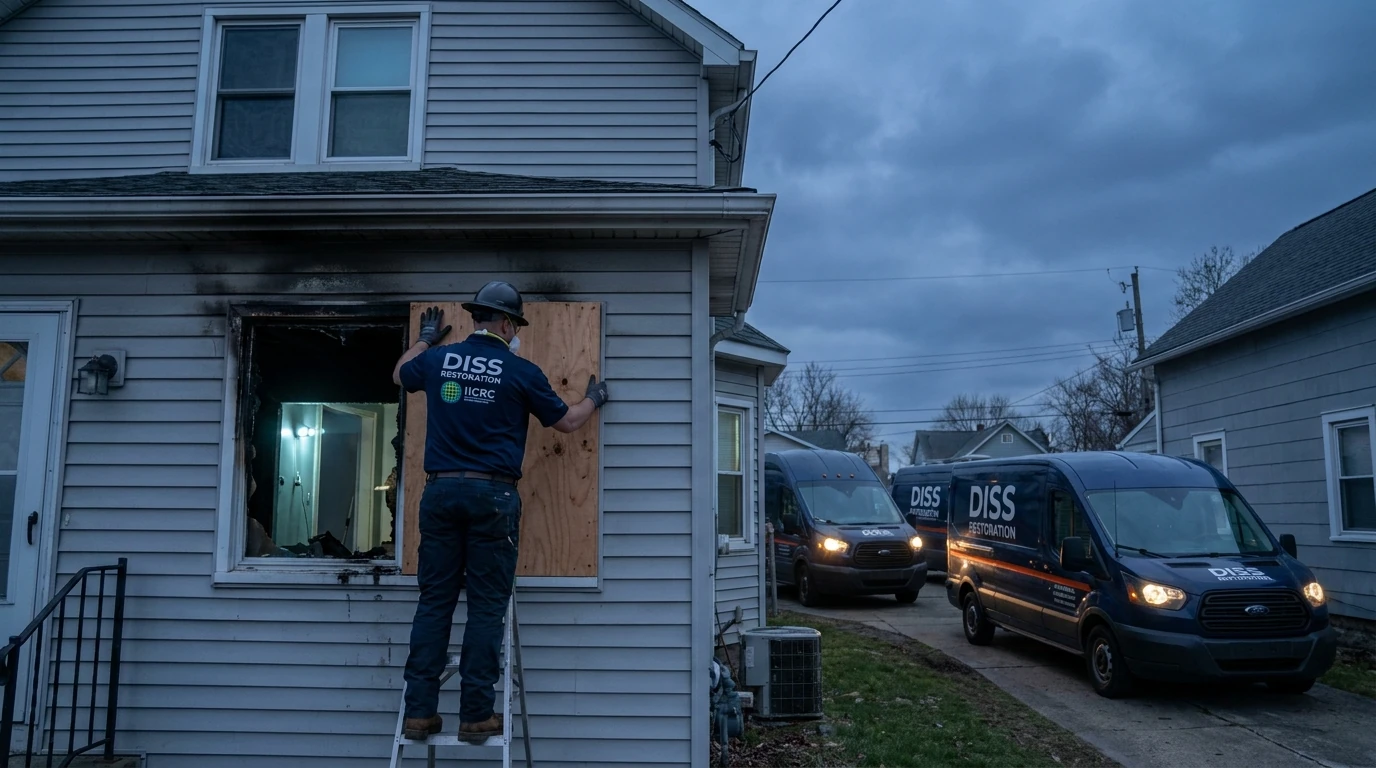
Fire damage restoration covers everything from the moment the fire is out to the moment your home is livable again. That includes emergency board-up and tarping to secure the structure, smoke and soot removal from walls, ceilings, contents, and HVAC systems, structural drying (fires trigger water damage from suppression hoses), odor neutralization using thermal fogging or hydroxyl generators, selective demolition of unsalvageable materials, and full reconstruction of affected areas.
Smoke damage is often more extensive than the burn area itself. In a typical residential fire, soot travels through the HVAC system and deposits on surfaces two or three rooms away from the fire origin. Protein smoke from kitchen fires, one of the most common calls in Youngstown’s older housing stock, leaves a nearly invisible film that smells intensely and requires specialized cleaning agents. An IICRC FSRT (Fire and Smoke Restoration Technician) certification means the crew has been trained specifically on these residue types and the correct cleaning chemistry for each.
What Should You Do in the First 24 Hours After a Fire?
In the first 24 hours, focus on safety, documentation, and getting a certified restoration crew on-site, not on cleaning anything yourself.
- Do not re-enter until cleared. The fire marshal or your local Youngstown Fire Department must clear the structure. Compromised floors, live electrical hazards, and carbon monoxide from smoldering materials are all real risks.
- Call your insurance company. Open the claim before any work starts. Your policy likely requires prompt notice. Ask specifically about Additional Living Expenses (ALE) coverage if you cannot stay in the home, this pays for a hotel while restoration is underway.
- Document everything before touching it. Walk through with your phone and photograph every room, every damaged item, every surface. Do this before the restoration crew moves anything. This documentation protects your claim.
- Call a certified restoration company. Ask specifically for IICRC FSRT certification, that credential covers fire and smoke restoration specifically, not just general water or mold work.
- Do not run your HVAC system. Turning on heat or air conditioning after a fire circulates soot particles through every duct in the house, spreading contamination and increasing the scope of the loss.
- Avoid DIY cleaning on soot. Dry soot smears when wiped with a wet cloth and embeds deeper into porous surfaces. Restoration technicians use dry sponges and chemical sponges in specific patterns before any wet cleaning begins.
For a broader look at how the full restoration process unfolds from this point, see The Fire Damage Restoration Process, Explained.
How Does Smoke and Soot Removal Actually Work?
Smoke and soot removal follows a systematic sequence defined by the IICRC S700 standard for fire and smoke restoration. It is not scrubbing walls until they look clean.
First, the crew categorizes the smoke type: wet smoke (low heat, smoldering fires), dry smoke (fast-burning, high-temperature fires), protein smoke (kitchen fires, nearly invisible but pungent), or fuel/oil smoke (furnace puff-backs). Each type requires different cleaning chemistry and technique. Dry smoke, for example, responds well to dry chemical sponges followed by alkaline cleaners. Protein smoke often requires enzyme-based degreasers and multiple passes.
After surface cleaning, odor neutralization addresses what you cannot see. Thermal fogging uses a solvent-based fog that penetrates the same porous pathways smoke traveled, chemically pairing with odor molecules. Hydroxyl generators work more slowly but are safe to run in occupied or partially occupied spaces. Ozone treatment is effective but requires the space to be completely vacated during treatment.
Air duct cleaning is almost always part of a post-fire scope. Soot deposits in ductwork recirculate every time the HVAC runs, recontaminating cleaned surfaces. A proper post-fire duct cleaning uses HEPA-filtered equipment and addresses registers, plenums, and the air handler itself.
Will Homeowners Insurance Cover Fire Damage Restoration in Youngstown?
Standard homeowners insurance policies in Ohio cover sudden and accidental fire damage, including the restoration work, structural repairs, and contents replacement, subject to your deductible and policy limits. Fire is one of the named perils almost universally covered under HO-3 policies.
What the claim process actually looks like: your adjuster will want a written scope of work from the restoration company before approving the full mitigation budget. A certified restoration company documents the damage using industry-standard estimating software (Xactimate is the most common), which produces line-item estimates your adjuster recognizes and can approve efficiently. Gaps in documentation, missing photos, undocumented contents, no moisture readings, are the most common reasons claims get underpaid.
Contents restoration is a separate line item from structural restoration. Many policies cover contents at actual cash value (ACV) rather than replacement cost value (RCV) unless you have a rider. Know which you have before the adjuster visits. A restoration company that offers contents restoration can inventory, pack out, and clean salvageable items, which often costs less than replacement and preserves sentimental items.
If your home is uninhabitable, document your hotel and meal receipts from day one. ALE reimbursement requires receipts, and many homeowners leave money on the table by not tracking expenses carefully in the first week.
Who Should You Call for Fire Damage Restoration in Youngstown, OH?
Call DISS Restoration at (724) 981-1441. They are an IICRC-certified firm with FSRT (fire and smoke) and ASD (structural drying) credentials, available 24/7, and serve Youngstown and the surrounding Mahoning Valley, including neighborhoods like Boardman and the South Side, and communities from Struthers to Hubbard.
When you call, have the property address, a brief description of the fire origin and affected areas, and your insurance company name ready. The crew will assess the structure, provide emergency board-up or tarping if needed, and begin the documentation process for your claim. A written scope of work is provided before mitigation begins, no open-ended authorizations.
For properties in Youngstown’s older housing stock, many built before 1978, asbestos-containing materials in floor tiles, insulation, or drywall compound may be present in the fire-affected area. A crew certified for asbestos abatement can test and safely remove those materials as part of the restoration scope rather than requiring a separate contractor.
Fire damage does not wait. The longer soot sits on metal fixtures, the more permanent the pitting. The longer smoke odor is untreated, the deeper it penetrates into framing and subfloor. Getting a certified crew on-site within the first 24 hours is the single most effective thing you can do to protect both your home and your insurance claim.
About DISS Restoration
DISS Restoration is an IICRC-certified firm based in Farrell, PA, serving Youngstown, OH and the surrounding Mahoning Valley since 2021 (licensed and insured). Their certified technicians hold IICRC credentials in fire and smoke restoration (FSRT), water damage restoration (WRT), structural drying (ASD), and mold remediation (AMRT), and are EPA Lead-Safe certified and OSHA trained. Services include fire damage restoration, water damage restoration, mold remediation, storm damage restoration, sewage cleanup, biohazard cleanup, contents restoration, asbestos abatement, emergency board-up and tarping, and general contracting across the region.