
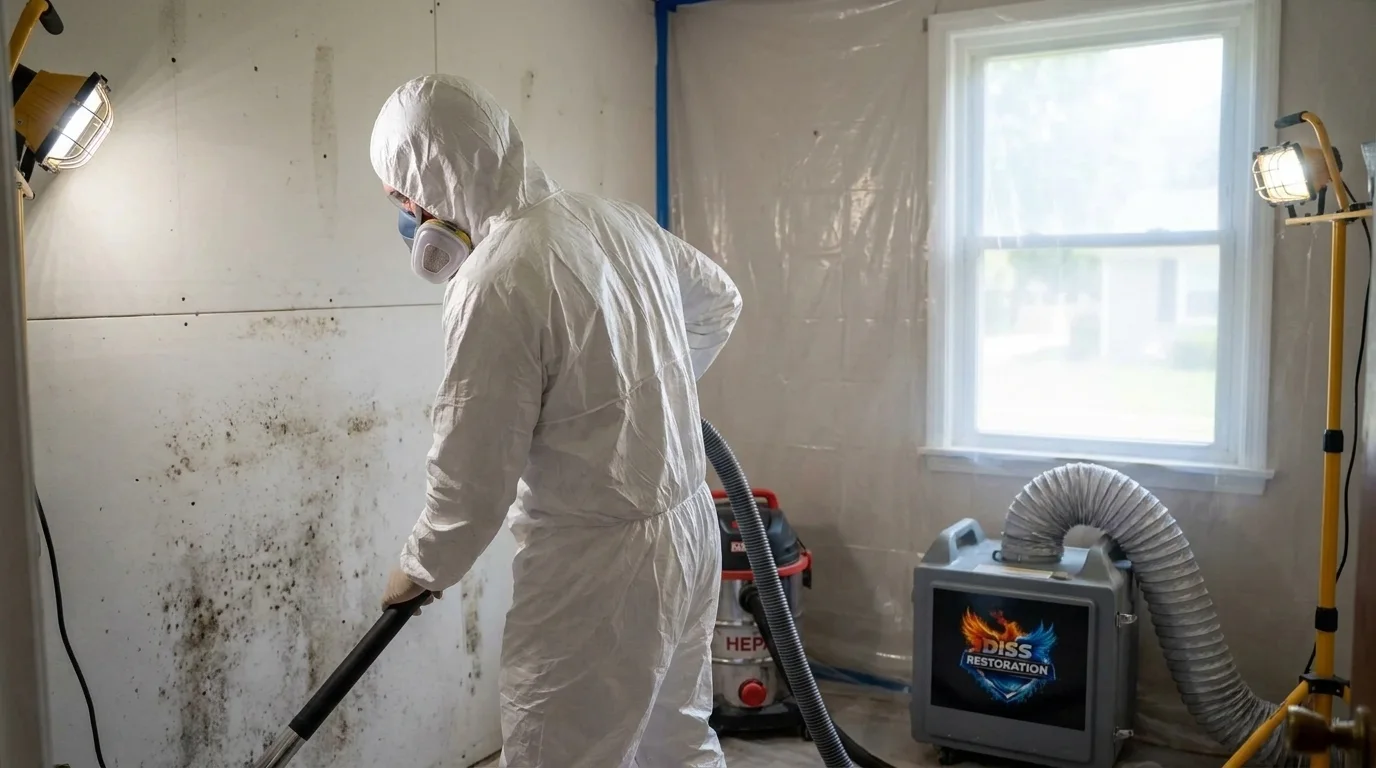
Mold Remediation in Youngstown
24/7 mold remediation in Youngstown, OH. IICRC-certified, insurance billing accepted. Call (724) 981-1441.
Our IICRC-certified technicians are headquartered right here in Youngstown and are typically on-site within 60 minutes of your call.
Youngstown’s winters hit hard and linger, and when snowmelt or a slow roof leak finds its way into an older home’s basement or wall cavity, mold doesn’t wait for spring to announce itself. The city’s housing stock — much of it built before World War II, with stone foundations, plaster walls, and cast-iron plumbing — creates conditions where moisture hides for weeks before a musty odor or a dark stain on the ceiling finally signals the problem. DISS Restoration’s IICRC AMRT-certified team handles mold remediation in Youngstown with the containment protocols and drying science that older construction demands.
Why Youngstown Properties See Mold Issues
The Mahoning Valley’s climate is a reliable mold accelerant. Youngstown averages more than 40 inches of precipitation a year, and the freeze-thaw cycles that run from November through March stress masonry and mortar joints in ways that newer Sun Belt construction never experiences. Water infiltrates through cracked block foundations, migrates behind plaster, and pools in crawl spaces that were never designed for modern vapor barriers.
The city’s pre-war housing stock compounds the problem. Balloon-frame construction — common in homes built before the 1950s — has open wall cavities that run floor to ceiling, meaning a single slow leak behind a bathroom tile can wick moisture up two stories before it shows on the surface. Cellulose insulation added during later energy retrofits absorbs and holds that moisture like a sponge, giving mold a sustained food source long after the original leak is repaired.
Our Mold Remediation Process in Youngstown
Mold remediation is not the same as mold cleaning. Wiping visible growth with a household product leaves the root structure — the mycelium — intact inside porous materials, and regrowth typically follows within weeks. The process that actually resolves the problem follows a defined sequence:
Assessment and air sampling. Before any physical work begins, we identify the moisture source and map the full extent of contamination. In Youngstown’s older plaster homes, surface readings can look clean while the lath behind the wall tests positive — we use thermal imaging and moisture meters, not visual inspection alone.
Containment. Affected areas are isolated with negative-air pressure barriers so that disturbing mold colonies during removal doesn’t push spores into clean living spaces. This step is non-negotiable in occupied homes.
Controlled removal. Compromised drywall, insulation, and wood framing are removed and bagged according to EPA guidelines. Where original plaster and lath can be saved — which matters in historic properties — we use HEPA-vacuum and antimicrobial treatment rather than demolition.
Structural drying. Remediation fails if the underlying moisture problem isn’t corrected. We deploy industrial dehumidifiers and air movers calibrated to the material density of the affected space, and we verify drying with post-treatment moisture readings before closing anything up.
Clearance. Final air quality verification confirms spore counts have returned to normal background levels before the space is released for reconstruction.
Mold in Youngstown’s Older Homes: A Process Note
Homes built during Youngstown’s steel-era boom — roughly the 1910s through the 1940s — present a specific challenge: lead paint. Many of these properties were painted and repainted over decades, and mold remediation that requires cutting or sanding painted surfaces triggers EPA Lead-Safe protocols. DISS Restoration carries EPA Lead-Safe Certification, which means we can handle remediation in pre-1978 homes without requiring a separate lead abatement contractor to come in first. That matters for scheduling and cost, especially when a mold problem is actively spreading.
Local Note
In Youngstown’s denser residential corridors, detached garages and shared alley-facing structures are often overlooked during mold assessments — homeowners focus on the main house while the garage, which shares a foundation drain or a downspout connection, continues feeding moisture into the property. We’ve found that structures along these alleys, particularly in neighborhoods with tightly spaced lots, frequently show active mold growth in wall framing and rim joists that never shows up on a surface inspection of the primary residence. If your home has an attached or nearby detached structure, ask that it be included in the initial assessment.
Working with Insurance on Mold Claims in Youngstown
Mold coverage varies significantly by policy, and Ohio homeowner policies often exclude mold that results from long-term neglect while covering mold that is a direct consequence of a covered peril — a burst pipe, a storm-driven roof leak, an appliance failure. The distinction matters because how the loss is documented determines whether your carrier will pay.
We photograph affected materials, log moisture readings, and produce a written scope of work that maps remediation costs to the underlying cause of loss. That documentation is what adjusters need to process a mold-related claim. We work directly with most major carriers and can communicate with your adjuster throughout the job so you’re not translating between technical findings and insurance language on your own.
If you’re dealing with mold in a Youngstown home — whether it’s a damp basement in a century-old property or a bathroom wall that never dried out after a plumbing repair — call DISS Restoration at (724) 981-1441. We’re available around the clock, and we’ll assess the problem before it spreads further.
Mold Remediation in Youngstown: Service Coverage
Frequently Asked Questions
How fast can you arrive for mold remediation in Youngstown?
How does Youngstown's climate affect how long mold remediation takes?
Are Youngstown's pre-war homes at higher risk for mold than newer construction?
Does the presence of lead paint in older Youngstown homes complicate mold remediation?
How do you handle mold remediation in an occupied Youngstown home?
Will my Ohio homeowner's insurance cover mold remediation in Youngstown?
Mold Remediation response in Youngstown
Most Youngstown calls see a technician on-site within 60 minutes from our Youngstown headquarters.