
Sewage Cleanup and Sanitization in Youngstown
24/7 sewage cleanup and sanitization in Youngstown, OH. IICRC-certified, insurance billing accepted. Call (724) 981-1441.
Our IICRC-certified technicians are headquartered right here in Youngstown and are typically on-site within 60 minutes of your call.
Youngstown’s aging sewer infrastructure and its mix of early-twentieth-century housing stock create conditions where sewage backups don’t just happen — they happen fast and spread further than homeowners expect. When a sewer line reverses into a basement on the city’s south side, raw sewage doesn’t stay on the floor; it wicks into century-old concrete block walls, saturates wood subfloors, and leaves behind pathogens that no amount of bleach and a shop vac can address safely. DISS Restoration responds 24/7 to sewage backup cleanup and sanitization calls throughout Youngstown and the surrounding Mahoning County area.
Why Youngstown Properties See More Sewage Backup Problems
Much of Youngstown was built during the steel boom of the early 1900s, and the combined sewer systems that served those neighborhoods were designed for a city with a much larger population drawing on them daily. As the city’s population declined over decades, those same lines — some original clay tile — now carry less daily flow, which means grease, sediment, and root intrusion accumulate faster. Heavy rain events compound the problem: Youngstown’s combined sewer system handles both stormwater and sanitary waste on the same lines, so a significant rainfall can push raw sewage backward through floor drains and basement toilets across entire blocks at once.
Homes in the Wick Park and Idora Park neighborhoods are particularly representative of this pattern. The large older homes in these areas often have original cast-iron drain stacks and clay lateral lines running to the street. Those laterals are prime candidates for root infiltration from the mature tree canopy that defines both neighborhoods. When a lateral collapses or blocks, the backup doesn’t stop at the cleanout — it fills the lowest fixture in the house first, which is almost always an unfinished basement.
Our Sewage Cleanup and Sanitization Process in Youngstown
Sewage cleanup is not a single step — it’s a sequenced process, and cutting corners at any stage leaves biological hazards behind.
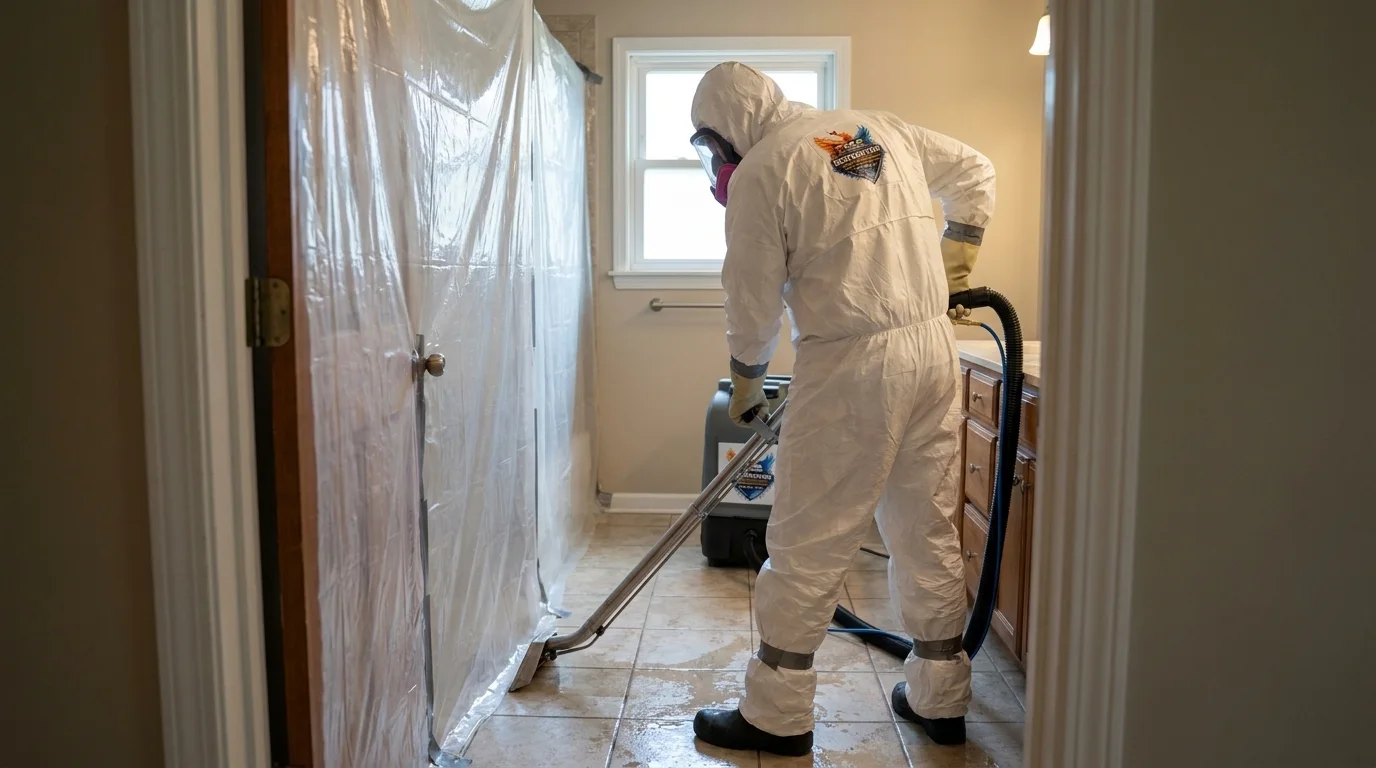
Containment and safety assessment come first. Raw sewage is classified as Category 3 water — the most contaminated classification under the IICRC S500 standard — and any porous material it has contacted for more than 24 hours is typically non-restorable. Our IICRC-certified technicians assess what can be dried and what must be removed before any equipment goes in.
Extraction and removal follows. Standing sewage is extracted using truck-mounted and portable units. Saturated materials — drywall, insulation, carpet, subfloor sections — are removed and bagged for disposal. In Youngstown’s older homes, this often means dealing with subfloor assemblies that include original tongue-and-groove boards over floor joists rather than modern OSB, which holds moisture differently and requires careful evaluation before a drying decision is made.
Sanitization and antimicrobial treatment address what extraction cannot. EPA-registered disinfectants are applied to all affected structural surfaces, and the space is treated to eliminate the bacteria and viruses associated with raw sewage exposure. This is not optional — it’s the step that determines whether the space is actually safe to reoccupy.
Structural drying closes the job. Our IICRC ASD-certified technicians place desiccant or refrigerant dehumidifiers and air movers calibrated to the specific conditions of the space, and moisture readings are logged until materials reach accepted drying goals.
Navigating Youngstown’s Permit and Utility Landscape
Depending on the scope of a sewage backup, work may intersect with the City of Youngstown’s building and plumbing permit requirements, particularly if drain lines need to be repaired or replaced as part of the restoration. Ohio EPA regulations also govern the disposal of sewage-contaminated materials. We coordinate with the appropriate city departments and licensed plumbing contractors when the scope of damage extends to line repair, so homeowners aren’t left managing multiple contractors independently during an already stressful situation.
For insurance claims, sewage backup coverage in Ohio is typically a separate endorsement from standard homeowners policies — many Youngstown homeowners discover this only after a loss. We document the damage thoroughly with photographs, moisture readings, and written scope so your adjuster has what they need regardless of which carrier holds your policy.
Local Note
In Youngstown’s Idora Park neighborhood and other areas with mature urban tree canopy, root intrusion into clay laterals is one of the most common causes of recurring sewage backups — but the roots themselves are rarely the whole story. The clay tile joints that roots exploit are often already offset or cracked from decades of soil movement and freeze-thaw cycling. A camera inspection of the lateral after cleanup frequently reveals that the line needs lining or replacement to prevent the next backup, not just clearing. We flag this for homeowners and can coordinate with a licensed plumber so the structural cause gets addressed alongside the cleanup.
If you’re dealing with sewage in your basement or crawl space right now, the clock matters — bacterial colonization of porous materials accelerates in the first 24 to 48 hours. Call DISS Restoration at (724) 981-1441 any time, day or night, for sewage cleanup and sanitization in Youngstown and throughout Mahoning County.
Sewage Cleanup and Sanitization in Youngstown: Service Coverage
Frequently Asked Questions
How fast can you arrive for sewage cleanup and sanitization in Youngstown?
How quickly can DISS Restoration reach homes in the Wick Park or Idora Park areas for a sewage backup?
Does Youngstown's combined sewer system make basement sewage backups more likely during storms?
Are older homes in Youngstown harder to sanitize after a sewage backup?
Does my Youngstown homeowners insurance cover sewage backup cleanup?
What does Category 3 water mean, and why does it matter for sewage cleanup in my Youngstown home?
Sewage Cleanup and Sanitization response in Youngstown
Most Youngstown calls see a technician on-site within 60 minutes from our Youngstown headquarters.