
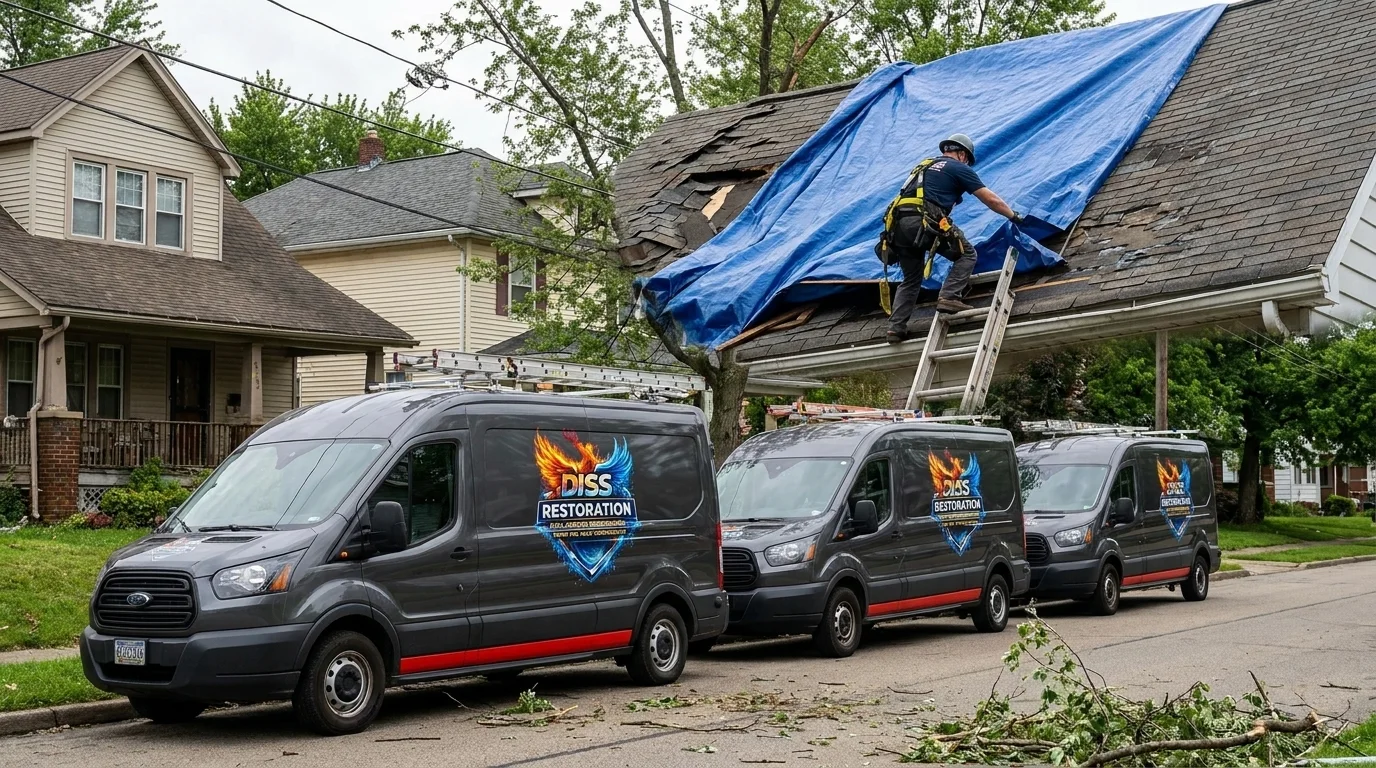
Storm Damage Restoration in Youngstown
24/7 storm damage restoration in Youngstown, OH. IICRC-certified, insurance billing accepted. Call (724) 981-1441.
Our IICRC-certified technicians are headquartered right here in Youngstown and are typically on-site within 60 minutes of your call.
Youngstown sits squarely in the Great Lakes snow belt, where lake-effect systems off Lake Erie can stack a foot of wet, heavy snow in hours, and spring derecho lines push through the Mahoning Valley with little warning. That combination — sudden high winds, saturated soil, and aging tree canopy over densely built residential blocks — means storm damage here rarely looks like the tidy “before and after” you see in national ads. It looks like a 70-year-old oak through a porch roof, shingles stripped down to bare decking, or a basement wall letting in runoff because the ground is already at capacity.
Why Youngstown Properties Are Especially Vulnerable to Storm Damage
Much of Youngstown’s housing stock was built between the 1910s and 1950s, when the steel industry was at full capacity and neighborhoods like Brier Hill and the North Side filled in quickly with wood-frame construction. Those homes have character — solid plaster walls, old-growth lumber framing, slate or clay-tile roofs — but they also carry decades of deferred maintenance and materials that respond to storm stress differently than modern construction.
Slate and clay tile hold up well in normal weather, but a single large hail event or falling limb can crack tiles in ways that aren’t visible from the ground. Water then tracks under the break, saturates the roof deck, and works its way into the attic before anyone notices a stain on the ceiling below. Wood-frame walls from this era also tend to have minimal or degraded vapor barriers, so wind-driven rain that gets behind siding can wet the sheathing and stay there.
The Mahoning Valley’s clay-heavy soil compounds the problem. After a heavy storm, that soil holds water rather than draining it, which keeps hydrostatic pressure against foundation walls long after the rain stops. Homes with block or poured-concrete basements — common throughout Youngstown’s older neighborhoods — can take on seepage days after the storm event itself.
Our Storm Damage Restoration Process in Youngstown
When a storm call comes in, the first priority is stopping ongoing damage. That means emergency tarping of compromised roofs, boarding breached windows or doors, and — if water has entered — beginning extraction before it migrates into subfloor assemblies or wall cavities. Because many Youngstown homes have plaster-over-lath interiors, water can wick laterally through lath channels well beyond the visible wet spot. Thermal imaging helps locate that hidden saturation without unnecessary demolition.
Once the structure is stabilized, the scope shifts to documentation. DISS Restoration’s IICRC-certified team photographs and measures every affected area, producing the kind of itemized loss documentation that insurance adjusters and carriers expect. Structural drying — governed by the IICRC S500 and S520 standards — runs until moisture readings return to pre-loss baselines, not just until surfaces feel dry to the touch.
Tree and debris removal is coordinated alongside the structural work rather than sequenced after it, so the crew isn’t waiting on a separate contractor to clear a limb before they can assess the decking underneath.
Reaching Youngstown Neighborhoods Around the Clock
DISS Restoration is based in Youngstown, which means response to neighborhoods across the city — from the South Side to the North Side, from Brier Hill to Boardman-adjacent corridors — doesn’t require a long highway run. The team is available 24/7, so a storm that rolls through at 2 a.m. gets the same response as one that hits on a Tuesday afternoon. For property managers overseeing multi-unit buildings, that after-hours availability matters: water moving through a shared wall at midnight doesn’t wait for business hours.
Youngstown Insurance Coordination
Most homeowner policies cover sudden storm damage — wind, hail, falling trees — but the documentation burden falls on the property owner to prove the loss. DISS Restoration handles that documentation from the first site visit: moisture readings, photo logs, material measurements, and a written scope that matches the line-item format carriers use. For older Youngstown homes where a storm event reveals pre-existing deterioration alongside fresh damage, clear documentation of what is storm-caused versus what predates the event is especially important for a clean claim.
Local Note
In Youngstown’s older residential blocks — particularly in areas with mature tree canopy and alley-accessed properties — storm debris staging can be complicated by narrow lot widths and shared rear access. When a large limb or section of roofing material needs to be removed, equipment positioning sometimes has to be planned around neighboring structures and utility lines that run through the alley rather than overhead on the street. It’s a small detail, but getting it wrong adds hours to an already stressful day. Working in this city regularly means knowing to check alley clearance before the crew arrives, not after.
If a storm has left your home exposed or taken on water, call DISS Restoration at (724) 981-1441. The team is available around the clock, and getting eyes on the damage quickly — before the next rain event or a temperature drop — is the single most effective thing you can do to limit what a Youngstown storm ultimately costs you.
Storm Damage Restoration in Youngstown: Service Coverage
Frequently Asked Questions
How fast can you arrive for storm damage restoration in Youngstown?
How quickly can DISS Restoration reach Brier Hill or the North Side after a storm?
Youngstown gets a lot of lake-effect snow — does that affect how storm damage is assessed compared to a summer wind event?
Does Youngstown's older housing stock — plaster walls, slate roofs — change the drying timeline after storm water intrusion?
Will my insurance carrier accept the documentation DISS Restoration provides for a Youngstown storm claim?
A tree came down on my roof during a Mahoning Valley storm — what should I do before the crew arrives?
Storm Damage Restoration response in Youngstown
Most Youngstown calls see a technician on-site within 60 minutes from our Youngstown headquarters.